
AAV Vector Variants for Ocular Gene Delivery
Keywords
AAV vectors, ocular gene therapy, intravitreal injection, photoreceptor cells, retinal pigment epithelium
Invention Novelty
The technology describes novel variants of adeno-associated viral vectors designed for more efficient gene delivery to the eye. The focus is on specifically modified AAV capsids, particularly based on AAV2, containing defined peptide insertions of the AAV2 capsid. The inserted peptide sequences alter the surface properties of the capsid so that vectors can more effectively penetrate retinal barriers after intravitreal administration.
Value Proposition
The invention addresses the safe and effective delivery of therapeutic genes into difficult-to-reach cell layers of the retina. Compared with known technologies the new AAV vector variants demonstrate improved penetration of retinal layers and stronger transduction of photoreceptor cells as well as other retinal cell types. Due to their improved transduction efficiency, lower vector doses are sufficient, therefore reducing immune reactions, side effects and manufacturing costs.
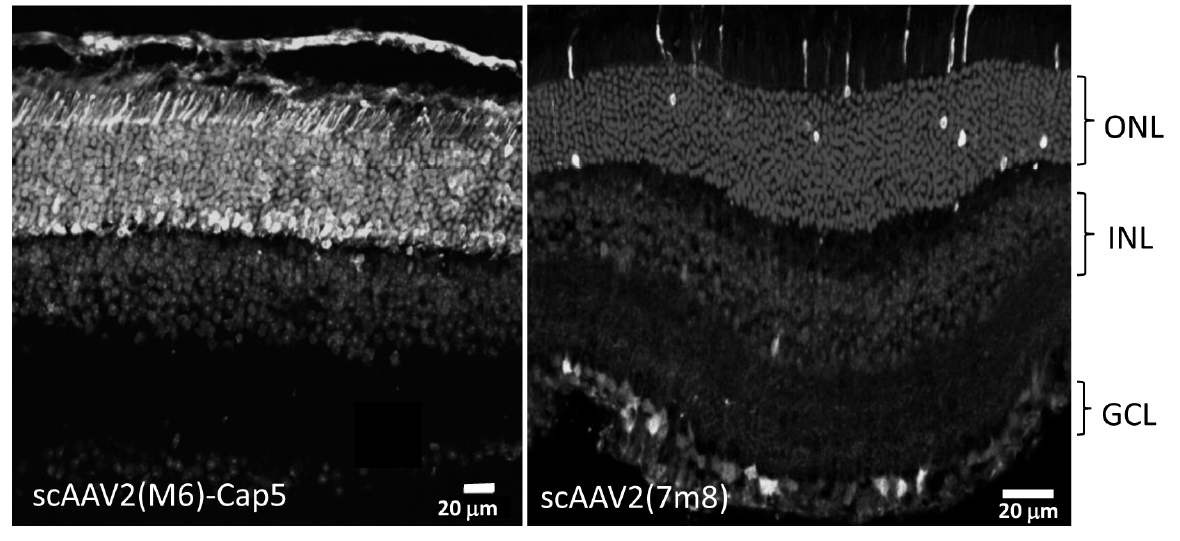
Comparison of transduction with novel scAAV2 (M6) Cap5 capsid versus state-of-the art AAV(7m8) capsid reveals highly efficient expression of mCitrine in photoreceptor cells of the outer nuclear layer (ONL).
(source: Büning et al.)
Technology Description
The technology is based on recombinant AAV vectors whose capsid proteins have been optimized by peptide insertions without substantially impairing viral assembly. Inserted peptide sequences alter the surface properties of the capsid so that newly designed vectors can more effectively penetrate retinal barriers. Thus, the vectors can carry single-stranded or self-complementary genomes and deliver different therapeutic payloads, including genes encoding functional proteins, such as siRNA, shRNA, CRISPR/Cas components or light-sensitive proteins such as opsins and channel-rhodopsin. Preclinical data show strong pan-retinal expression after intravitreal injection, particularly in photoreceptors of the outer nuclear layer of the retina, making the technology a promising basis for the next generation of ocular gene therapies.
Commercial Opportunity
In-licensing or developmental cooperation is possible.
Development Status
In vivo studies in disease related mouse models have been performed.
Patent Situation
Patents with priority of 2019 have been granted in Europe (EP 4051694 B1), USA (US 12,509,705 B2) and Japan (JP 7791546 B2). A patent application in China is pending.
Further Reading
Pavlou et al. 2021. Novel AAV capsids for intravitreal gene therapy of photoreceptor disorders. EMBO Mol Med. 2021. 13(4):e13392. doi: 10.15252/emmm.202013392. Epub 2021 Feb 22. PMID: 33616280
Huang et al. 2025. Adeno-Associated Virus Vectors in Retinal Gene Therapy: Challenges, Innovations, and Future Directions. Biomolecules. 15(7):940. doi: 10.3390/biom15070940. PMID: 40723812

Institute of Origin