Base editing enzymes for multiplex editing with simultaneous gene knock-in and knock-out
Keywords
Base editors, gene editing tool, cell and gene therapies, CAR T cells, autoimmunity, allogeneic cell therapy
Invention Novelty
Researchers at Charité have developed a non-viral Base Editor Knock-In (BEKI) genome editing strategy, that simultaneously links a knock-in, e.g. of a chimeric antigen receptor (CAR), with knock-out (KO) of one or several other genes. This reaction is mediated by a nickase-base editor fusion protein and several single guide RNAs (sgRNAs) and allows complex gene editing reactions in a single transfection reaction.
Value Proposition
The development of successful cell therapies requires multiplex editing and efficient CMC processes, but the need for multiple platforms and consecutive processing steps often leads to complexity and increased costs. The BEKI gene editing strategy offers a solution by combining the insertion of a knock-in and the knock-out of other genes, reducing toxicity and off-target effects (Fig. 1A). Unwanted side effects, such as the occurrence of chromosomal translocations, are reduced to an almost non-detectable minimum (Fig. 1C). This approach enhances the safety profile, minimizes the loss of primary cells, reduces GMP costs, and simplifies the optimization and validation process, making it an attractive option for cell therapy development.
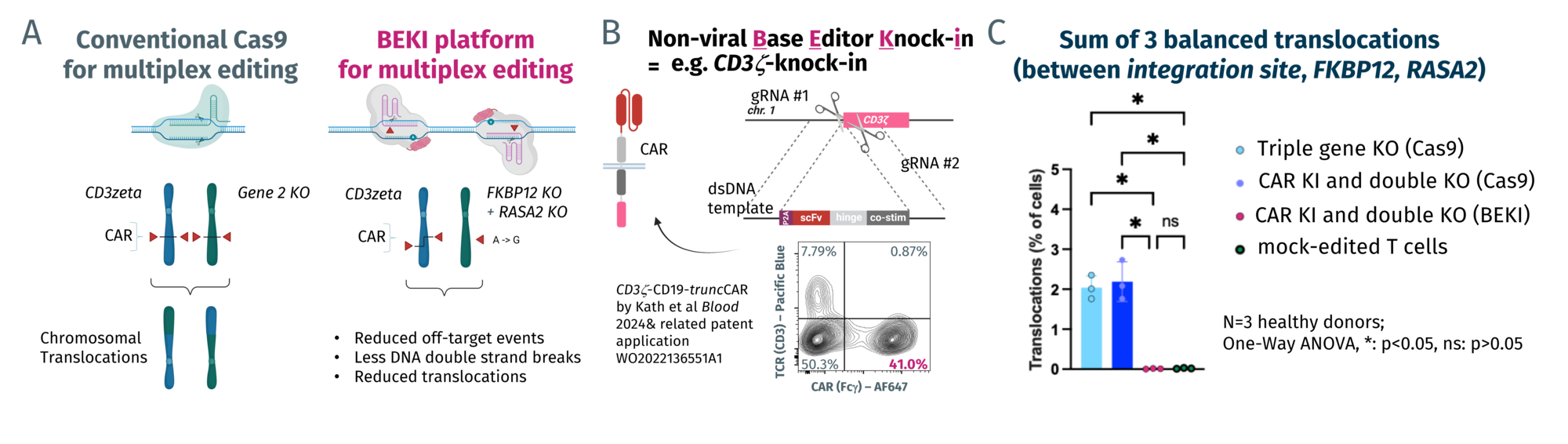
Fig. 1 The BEKI platform is highly amenable for multiplexing, with reduced toxicity and off-target effects, and allows optimization of manufacturing as only a single transfection is needed (provided by Wagner Lab)
Technology Description
The inventors conducted a screening of over 40 different guide RNA configurations to establish design rules for efficient execution of BEKI at several sites relevant to create CAR/TCR-T cells, including TRAC, CD3z, and B2M (Fig. 1B). They successfully established proof-of-principle that BEKI can be combined with additional KOs of more than three sites simultaneously, achieving high editing rates of over 80% for all targeted sites. Furthermore, the inventors demonstrated the production of highly potent anti-CD19 CAR T cells with edits to enhance CAR-dependent signaling (RASA2 KO), induce drug resistance, and protection against allo-rejection (HLA genes, B2M, CIITA).
Commercial Opportunity
In-licensing or collaboration for further development.
Development Status
The practical suitability of BEKI technology has been extensively validated in vitro.
Patent Situation
A European priority application was filed in October 2024.
Further Reading
Kath J, et al. Integration of ζ-deficient CARs into the CD3ζ gene conveys potent cytotoxicity in T and NK cells. Blood. 2024 Jun 20;143(25):2599-2611. doi: 10.1182/blood.2023020973.
Licensing Contact

Dr Céline Christiansen-Mensch
Technology ManagerT: +49 (0)1590 4836722
christiansen@ascenion.de
Institute of Origin