Blood-based TB precision medicine: Flow-cytometric models for immunoprofiling and treatment monitoring
Keywords
tuberculosis (TB), flow cytometry, whole blood, immune-cell profiling, PD-L1, machine learning, treatment monitoring
Invention Novelty
Tuberculosis (TB) diagnosis and treatment monitoring still rely substantially on microbiological testing, which may be slow or difficult when suitable respiratory samples are unavailable. The innovation is a whole-blood immune-cell profiling approach that uses multiparameter flow cytometry and machine learning to distinguish adults with pulmonary TB from healthy controls and to characterize changes during treatment. Two alternative five-cell-population models, TB5LF change and TB5Lasso, were developed from a broader set of flow-cytometry measurements.
Value Proposition
TB5 provides a host-response readout based on immune-cell populations rather than RNA expression. In the reported study, both models distinguished patients with TB at baseline from healthy controls and from patients at the end of treatment. TB5Lasso also showed an inverse correlation with a composite disease-severity score. These findings support further evaluation of TB5 for blood-based TB immunoprofiling and treatment monitoring.
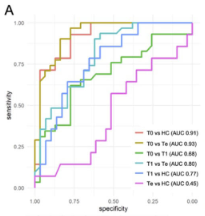
Model validation in test cohort. Area under the curve (AUC) values for comparisons between pateints at different time points, either prior to therapy start (T0), 14 days within therapy (T1), and end of therapy (Te), and healthy controls (HC) (Eggeling et al., 2026).
Technology Description
The models were developed using prospectively collected whole-blood samples from 51 adults with culture-confirmed pulmonary TB and 34 healthy controls. Samples from TB patients were assessed before treatment, after 14 days of treatment and at the end of treatment. Multiparameter flow cytometry measured 386 immune-cell populations across seven antibody panels. Machine-learning approaches selected five cell populations for each model.
Both models included PD-L1+CD80− neutrophils and PD-L1+HLA-DR+ CD4+ lymphocytes. TB5Lasso included three additional populations: CCR4−CXCR3+ CD4+ T cells, CD56+ Vδ2+ γδ T cells and CD56bright NK cells. In the study cohort, TB5LF change distinguished baseline TB from healthy controls (AUC 0.89) and from end-of-treatment samples (AUC 0.92). Corresponding AUCs for TB5Lasso were 0.91 and 0.93.
Commercial Opportunity
TB5 is available for co-development and in-licensing, for example for analytical and clinical validation, assay simplification or evaluation on compatible flow-cytometry platforms.
Development Status
The published study was conducted at a single German clinical center. Further validation in larger, independent and clinically representative cohorts is needed, alongside assessment of inter-laboratory reproducibility and a standardized, practical assay workflow. TB5 should currently be regarded as a research-stage biomarker, not a clinically deployable diagnostic test.
Patent Situation
The patent family has a priority date of 12 September 2025. The international patent application PCT/EP2026/077464 has been filed in Sept. 2026.
Further Reading
Eggeling et al. (2026) Front. Immunol. 17: 1829438.
Licensing Contact

Dr Torsten Stachelhaus
Technology ManagerT: +49 40 1888 43 48
stachelhaus@ascenion.de
Institute of Origin