
Blood-based TB precision medicine: transcriptomic model for cure-associated treatment-end prediction
Keywords
tuberculosis (TB), MDR-TB, XDR-TB, transcriptomic analysis, whole blood, therapy monitoring, individualized treatment duration
Invention Novelty
Tuberculosis (TB), including multidrug-resistant TB (MDR-TB), remains a major global health challenge. Treatment duration varies between patients, while decisions to stop therapy are often based on standardized regimens and microbiological monitoring. The innovation is a 22-gene, whole-blood transcriptomic model that estimates whether a patient has reached a cure-associated end-of-treatment time point. It was developed for drug-susceptible (DS-TB) and MDR-TB and is intended to support research into individualized treatment duration.
Value Proposition
The model provides a host-response readout at multiple time points during treatment and helps to identify patient-specific, cure-associated treatment-end time points. In the reported MDR-TB cohorts, retrospective model application suggested shorter treatment durations for many patients than those observed in clinical practice. After prospective validation, the approach would support studies of individualized treatment duration and potentially reduce treatment burden, adverse effects and costs.
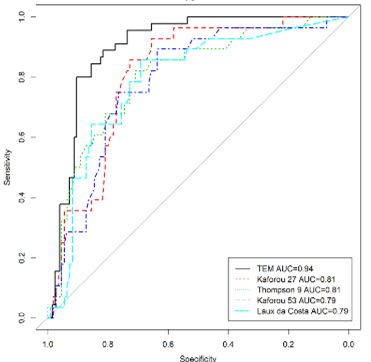
ROC curves for therapy end detection. Proprietary transcrisptomic model (TEM): black; known published models: colored (from Heyckendorf et al., 2021)
Technology Description
The model was developed using longitudinal whole-blood RNA-expression data from adults with pulmonary DS-TB or MDR-TB. Blood samples were collected before and during treatment and analyzed using gene-expression microarrays. A multi-step modelling process combined three components: a therapy outcome score, a therapy progression score and a gene set distinguishing ongoing treatment from successful treatment completion. These components were integrated into a final 22-gene model that estimates the probability of a cure-associated end-of-therapy time point. In an independent DS-TB validation cohort, the model identified treatment-end time points with an AUC of 0.94 (95% CI 0.90–0.98). Across three MDR-TB cohorts, retrospective model application suggested reductions in treatment duration of 161–218 days. The model was evaluated in adult, HIV-negative pulmonary-TB cohorts; performance in other populations and under other treatment regimens remains to be established.
Commercial Opportunity
The model is available for co-development and in-licensing, for example for clinical validation, assay development or evaluation as a biomarker in TB treatment studies.
Development Status
The 22-gene model was developed in identification cohorts and evaluated in independent DS-TB and MDR-TB cohorts in Germany and Romania. It outperformed the published signatures included in the study for identifying cure-associated treatment-end time points in the DS-TB validation cohort.
Patent Situation
The international application WO2021/165523A1 has entered the national/regional phases in AU, EP, and the US.
Further Reading
Heyckendorf et al. (2021) Eur. Respirat. J. 58: 2003492; and
Kontsevaya et al. (2021) Eur. Respirat. Rev.30 200377.
Licensing Contact

Dr Torsten Stachelhaus
Technology ManagerT: +49 40 1888 43 48
stachelhaus@ascenion.de
Institute of Origin