BreakTag - Novel method for detection of ds-breaks and analysis of CRISPR-induced on- and off-target effects
Keywords
Genome editing, CRISPR/Cas, Cas9, off-target, DSB, gRNA, tagmentation, cell engineering, T cell, cell therapy
Invention Novelty
BreakTag is a high throughput method for detecting the locations and end-structure of on- and off-target DNA double-strand breaks (DSBs) induced by genome editing nucleases in vitro via preparation of a DNA library for next-generation sequencing, allowing flexible preclinical testing for optimization of nuclease cleavage and guide RNAs design for higher specificity.
Value Proposition
BreakTag relies on direct labelling of DNA DSB ends. It is preferably used for discovering the frequency, location and end-structures of DSBs induced by genome-editing nucleases at on- and/or off-targets, in particular CRISPR nucleases such as Cas9 and Cas12 in vitro or in cells. The BreakTag method can also be adapted to test off-target sites for base editors by introducing artificial DSBs at the nicked site using the repair enzyme endonuclease V. Compared to other known methods for analyzing off-target effects, BreakTag’s enrichment protocol is simplified and robust, and does not require steps such as cell transfection, circularization of the genome, in vitro transcription, nested PCR or whole genome sequencing. These advantages in combination with the short protocol time of less than 6 hours would allow this methodology to be easily implemented into research or clinically routine as for instance, to screen for gRNAs with minimal off-targets and increased editing precision.
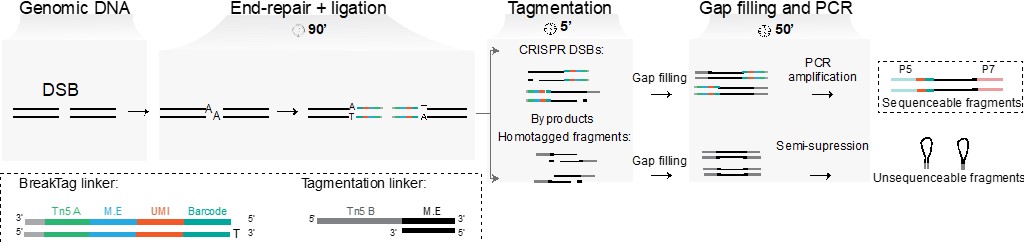
Schematic illustration of the BreakTag workflow
[provided by IMB; click to enlarge]
Technology Description
BreakTag is a 4-step protocol for profiling CRISPR off-targets in a cell-free or cell-based mode. The protocol uses genomic DNA, either extracted from living cells or in vitro digested with ribonucleoprotein complexes after CRISPR delivery. Free DSB-ends are labeled with a BreakTag linker, followed by a second linker which is rapidly added via a tagmentation step. DNA fragments that are labeled with both linkers are selectively amplified during a PCR step, whereas by-products (such as non-DSBs) form intramolecular hairpins are not enriched, resulting in ready-to-sequence libraries.
Commercial Opportunity
The technology is available for licensing or further co-development.
Development Status
BreakTag was implemented in vitro testing several nucleases (Cas9 variants and Cas12). Using cell-free BreakTag, the cleavage by SpCas9 at more than 150,000 endogenous on-target and off-target sites targeted by approximately 3,500 single guide RNAs was assessed.
Patent Situation
WO2024/033378A1 was nationalized in US and EP.
Further Reading
Longo, Sayols et al. (2024) Nat. Biotechnol., https://doi.org/10.1038/s41587-024-02238-8

Institute of Origin