
Circular RNA Circ-INSR Protects Against Doxorubicin-Induced Heart Failure
Invention Novelty
The invention identifies circular RNA Circ-INSR as an evolutionarily conserved and functional regulator of cardiomyocyte survival and mitochondrial homeostasis. While numerous circular RNAs have been described previously, this technology demonstrates for the first time the direct therapeutic relevance of Circ-INSR for the prevention and treatment of heart failure and therapy-associated cardiotoxicity. Circ-INSR is significantly downregulated in diseased hearts and following treatment with anthracycline chemotherapeutics like doxorubicin. In contrast, experimental overexpression of Circ-INSR markedly reduced cardiomyocyte apoptosis and improved cardiac function in preclinical models including human cardiomyocytes and a mouse model of chronic doxorubicin-induced cardiotoxicity. Circ-INSR interacts with the mitochondrial protein SSBP1 (single-stranded DNA-binding protein 1), which is essential for mitochondrial DNA stability and replication. This interaction preserves mitochondrial function, enhances cellular metabolic capacity, and reduces mitochondrial damage.
Value Proposition
Clinical management of doxorubicin-induced cardiotoxicity has largely relied on dexrazoxane, beta-blockers, RAAS inhibitors and liposomal formulations. The therapeutic use of a conserved, promotable circRNA to restore mitochondrial function represents a mechanistically new approach. By restoring or enhancing Circ-INSR activity, cardiomyocytes can be protected from apoptosis, mitochondrial performance can be maintained, and the development of heart failure may be prevented. The technology is particularly attractive for cardio-oncology applications because it may protect patients during or after anthracycline therapy without compromising the antitumor efficacy of chemotherapy.
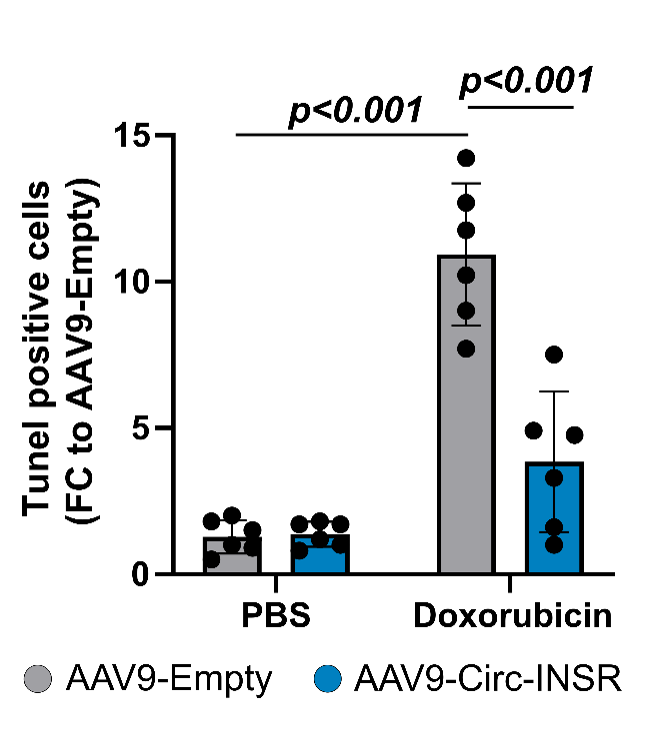
Circ-INSR therapy protects from doxorubicin-induced cardiotoxicity in vivo. TUNEL staining results in AAV9-Empty and AAV9-Circ-INSR heart sections with/without doxorubicin treatment (Lu et al.).
Technology Description
The technology is based on a pharmaceutical composition that promotes the expression and/or activity of Circ-INSR. Knockdown of Circ-INSR increases apoptosis after doxorubicin treatment, while AAV6-mediated overexpression or recombinant Circ-INSR RNA rescues doxorubicin-induced apoptosis mouse, rat and human cardiomyocytes in vitro. AAV9-mediated overexpression protects against cardiac apoptosis and improves heart function in a mouse model of chronic doxorubicin-induced cardiotoxicity. The metabolic protective effect is mediated by binding of Circ-INSR to the protein SSBP1 (single-stranded DNA-binding protein 1), a housekeeping gene involved in mitochondrial biogenesis. Delivery can be achieved via expression vectors, preferably heart-specific AAV, or via in vitro-transcribed recombinant Circ-INSR.
Commercial Opportunity
The technology is available for licensing or co-development.
Development Status
Experimental overexpression of circINSR markedly reduced cardiomyocyte apoptosis and improved cardiac function in preclinical murine in vivo models and human tissue samples.
Patent Situation
European and US applications based on WO2021/074288 are pending.
Further Reading
Lu et al. (2022) A circular RNA derived from the insulin receptor locus protects against doxorubicin-induced cardiotoxicity. Eur Heart J. 2022 Nov 7;43(42):4496-4511. doi: 10.1093/eurheartj/ehac337.

Institute of Origin