Combination of menin and immunoproteasome inhibitors for the treatment of leukemia
Keywords
menin inhibitor, immunoproteasome inhibitor, acute myeloid leukemia, AML, MLL-r, NPM1 mutation
Invention Novelty
Therapeutic intervention with menin inhibitors often fails in MLLr or NPM1 driven leukemias and leads to the development of resistance or relapse. Prior therapeutic combinations, such as menin inhibitors with Bcl2 inhibitors, also led to short lived responses and intolerance. For the first time, the presented invention demonstrates the successful eradication of MLLr or NPM1 driven leukemias in vitro and in vivo by the use of a combination of menin and immunoproteasome inhibitors.
Value Proposition
The approach addresses a critical, previously unmet need in hard-to-treat MLLr or NPM1 driven leukemias through exploitation of a newly identified secondary dependency: the proteasome unit PSMB8/LMP7 was identified as a relevant target in MLL-rearranged acute myeloid leukemia (AML). By co-targeting menin and this immunoproteasome subunit, the combination achieves an outstanding synergistic effect. As normal blood formation is still preserved the technology offers an attractive therapeutic potential to treat MLLr or NPM1 driven leukemias.
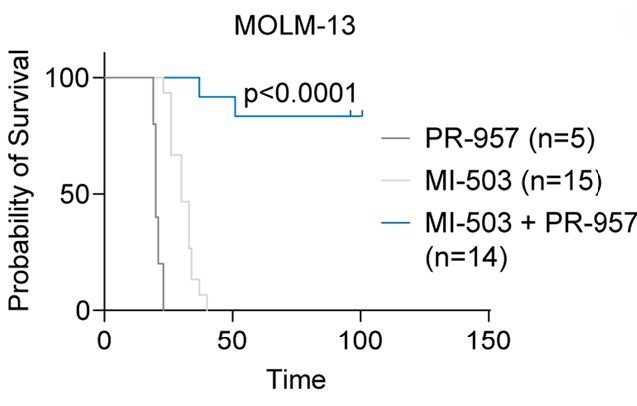
Survival curve of xenograft model with human MOLM-13 cells (human KMT2A-r AML cells). Cells were pre-treated ex vivo with immuno-proteasome inhibitor PR-957, menin inhibitor MI-503 or a combination of both. (source: Tubio-Santamaria et al.)
Technology Description
Mechanistically, the invention pairs a menin inhibitor (e.g., MI-503, SNDX-5613, KO-539, MI-3454) with an inhibitor targeting the immunoproteasome (e.g., PR-957/ONX-0914, Bortezomib, Carfilzomib, M3258), both at low therapeutic concentrations. Pharmacological deactivation of the proteasome unit PSMB8/LMP7 resulted in a decrease of cell proliferation, loss of self renewing capacity, reduction of oncogenic gene expression and displacement of MLLr altering leukemia cells in bone marrow. On the contrary, normal blood formation was not impaired by the inhibition of PSMB8/LMP7. Therefore, the combination of menin inhibition and immunoproteasome inhibition provides a synergistic effect with a significant increase in response up to the complete eradication of leukemic cells.
Commercial Opportunity
In-licensing and/or developmental cooperation is possible.
Development Status
In vivo studies were performed in a clinically relevant xenograft model.
Patent Situation
Patent applications in Europe and US (based on PCT/EP2023/081428) with priority of 2022 are pending.
Further Reading
Tubío-Santamaría N, Jayavelu AK, Schnoeder TM, Eifert T, Hsu CJ, Perner F, Heidel FH et al. 2023. Immunoproteasome function maintains oncogenic gene expression in KMT2A-complex driven leukemia. Mol Cancer. 22(1):196. doi: 10.1186/s12943-023-01907-7.

Institute of Origin