
CRISPR StAR: facilitating high resolution genetic screening in complex in vivo models
Keywords
CRISPR/Cas, sgRNA expression vector, stochastic activation, screening, essentialome, in vivo, organoids, reproducibility, reliability
Invention Novelty
CRISPR/Cas-based negative selection screens are conducted by looking for the depletion of certain sgRNAs; i.e., a gene targeted by a depleted sgRNA is considered essential. Corresponding screens face various obstacles, and their outcome largely relies (among others) on the quality of the sgRNA library used, the efficiency of transduction, the regeneration of transduced cells, and the cellular heterogeneity. To obtain reliable results, it is of particular importance that a certain representation of the sgRNAs is maintained throughout gene editing (ideally: >300 cells/sgRNA), which is easy to achieve in vitro, but difficult (if not impossible) in organoids and in vivo. CRISPR StAR solves this problem by allowing actual gene editing to be postponed until all growth- and transduction-related bottlenecks have been passed, and sgRNA representation has had a chance to recover. By integrating an internal control, it further allows highly reproducible and reliable screens even under conditions of low sgRNA representation.
Value Proposition
Negative selection screens are used to identify essential genes, which in turn represent targets for disease-specific therapies. The approach is very promising and widely used, but also hampered by the fact that common methods do not provide reliable data in vivo. However, only in complex in vivo systems meaningful results can be obtained for a given disease model. Due to the limitations of conventional methods, true hits are hidden among many false-positive hits, making the identification and validation of novel disease targets, e.g., for cancer therapy, extremely difficult. CRISPR StAR overcomes this bottleneck by enabling the conduction of highly reliable and reproducible screens in complex in vivo systems and under conditions of low sgRNA representation.
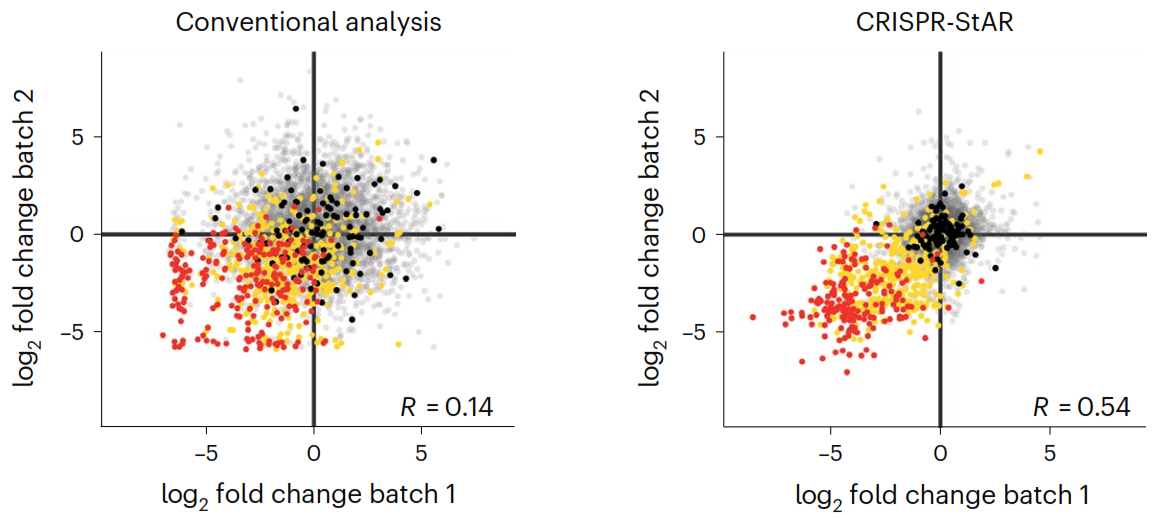
Comparison of conventional anaylsis and CRISPR-StAR in genome-wide in vivo screens. LFC correlations of overlapping genes in two batches (red: in vitro depleting; black: non-essential, grey: neutral, yellow: others (Uijttewaal et al., 2024).
Technology Description
CRISPR StAR is based on CRISPR switch (see Partnering Opportunity for 44-00004), and takes advantage of sgRNA expression vectors, in which the sgRNA gene is interrupted by a disruption cassette flanked by a pair of recombinase recognition sites, which upon recombination facilitate the formation of an active sgRNA. However, the CRISPR StAR vector also carries a second pair of recombinase recognition sites which upon recombination facilitates the formation of an inactive sgRNA that serves as an internal control. Both recombination events are mutually exclusive and strictly stochastic, and accordingly yield a specific ratio of active and inactive sgRNA. In negative selection screens, the innovative sgRNA constructs are activated only after their representation has recovered. True essential genes are determined not only by depletion of the corresponding sgRNA (which is per se difficult to distinguish from a lack of transduction or recovery), but rather by a stochastic drift in the ratio of active and inactive sgRNA.
CRISPR-StAR's effectiveness was evaluated e.g. in vivo using a mouse melanoma cell line, with genome-wide screens conducted across 143 animals. On average, there were 2.3 cells per sgRNA or 8.7 cells per gene. CRISPR-StAR successfully distinguished between essential and non-essential genes in sparse and heterogeneous datasets, outperforming conventional CRISPR screening. It demonstrated superior performance in discriminating between in vitro depleting genes and controls. Reproducibility of two independently cloned datasets, generated two years apart, improved significantly with an R coefficient of 0.54. Overall, CRISPR StAR effectively reduces noise from data sparseness and heterogeneity, enhancing genetic screening in vivo.
Commercial Opportunity
CRISPR StAR is available for in-licensing.
Development Status
CRISPR StAR has been extensively and successfully studied in vitro, in organoids and in vivo.
Patent Situation
CRISPR StAR is protected by the international PCT application WO 2021/198233 A1.
Further Reading
Uijttewaal et al. (2024) Nat. Biotechnol., http://doi.org/10.1038/s41587-024-02512-0.
Licensing Contact

Dr Torsten Stachelhaus
Technology ManagerT: +49 40 1888 43 48
stachelhaus@ascenion.de
Institute of Origin