
CRISPRdetect – multiplexed RNA detection with reprogrammed tracrRNAs
Keywords
CRISPR-Cas, RNA detection, diagnostics, multiplexing, point-of-care (POC)
Invention Novelty
We present a scalable RNA detection platform that enables numerous applications for multiplexed diagnostics in clinical testing facilities and point-of-care (POC) testing.
Value Proposition
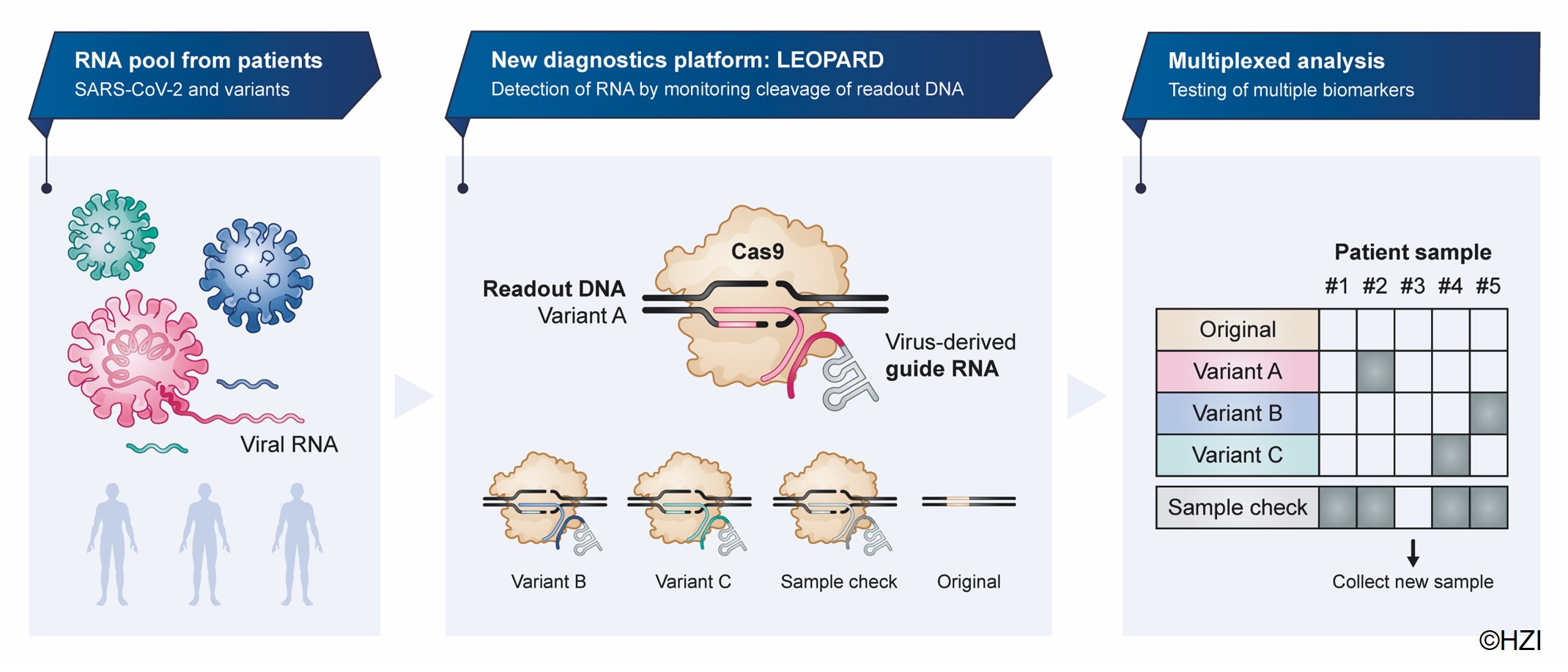
Diagnostic tests are crucial for gathering information about a person’s health, but many only provide limited insights, affecting decision-making in patient care. LEOPARD, our first-in-class technology platform, allows the collection of large amounts of data with a single test. Built on a novel CRISPR discovery, LEOPARD detects numerous RNA transcripts in parallel. It offers fast, multiplexed readouts with simple machinery, surpassing traditional methods like multiplexed PCR, next-generation sequencing, and mass spectrometry. Additionally, LEOPARD enables rapid point-of-care testing, providing the first multiplexed devices suitable for use outside clinical settings.
Technology Description
LEOPARD is based on a new discovery in CRISPR biology, where engineered tracrRNAs hybridize with biomarker RNA to create a guide RNA that directs sequence-specific DNA cutting via Cas9 nuclease. This technology enables fast and multiplexed RNA detection with simple, accessible machinery, making it a strong alternative to existing methods. It also shows great potential for point-of-care applications, providing rapid, multiplexed testing outside of traditional clinical environments.
Commercial Opportunity
The technology is offered for co-development and/or licensing
Development Status
Current efforts focus on the development of a multiplexed detection systems based on microarrays and lateral flow strips
Patent Situation
European priority filed Feb 2020; PCT WO2021170877 nationalized in AU, CA, CN, EP, IL, JP, KR, SG and US
Further Reading
Jiao et al. 2021. Science 372, 941–948
Licensing Contact

Dr Alejandro Restrepo Arango
Technology ScoutT: +49 531 618120-92
restrepo@ascenion.de
Institute of Origin