
Cytotoxicity Assay for detecting Cellular Damage
Keywords
Cytotoxicity assay, cellular damage, luciferase, high-throughput screening, mammalian cells, drug safety testing, diagnostic kit
Invention Novelty
The technology provides a quick, easy, robust, highly sensitive, and inexpensive in vitro assay for measuring cell damage by using a new luciferase reporter system based on a genetically modified eukaryotic cell that stably expresses an intracellular luciferase enzyme. This method is suitable for high-throughput studies of pathogenesis mechanisms of any microbe, for antimicrobial drug screening, and many other applications.
Value Proposition
Traditional cytotoxicity assays often rely on markers like LDH, which can be confounded by the presence of microbial components and require multiple wash steps, making them cumbersome and less accurate. The inventive new method, utilizing intracellular luciferase activity as a marker, offers a more straightforward and reliable means of detecting cellular damage. It is particularly advantageous for high-throughput screening applications, significantly reducing costs and complexity while enhancing specificity and sensitivity.
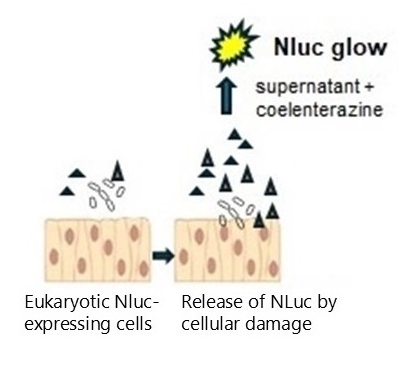
Luciferase reporter system based on Nluc cells
Technology Description
The technology involves an in vitro assay method that comprises the following steps: providing a genetically modified eukaryotic cell line that stably expresses an intracellular luciferase enzyme, cultivating the cells, exposing the cells to an agent suspected of causing cellular damage, and then detecting changes in luciferase activity in the culture medium by a simple reaction. The change in luciferase activity, compared to a control sample not exposed to the agent, indicates the extent of cellular damage. This method is applicable to a variety of cell types, including mammalian epithelial cells, and can be used to detect damage caused by a wide range of agents, including pathogens, drugs, and environmental factors. The expression system can be provided as ready-made cell line or as a transfection vector to generate use case-specific cell lines based on this principle.
Commercial Opportunity
The method has significant commercial potential in biomedical research, pharmaceutical development, and diagnostic applications. It can be developed into diagnostic kits for laboratory use, enabling researchers to efficiently screen for cytotoxic agents and evaluate cytoprotective compounds. Additionally, pharmaceutical companies can utilize this method for drug safety testing and to streamline the development of new therapeutics. Licensing opportunities are available for companies interested in integrating this innovative cytotoxicity assay into their research and development processes.
Development Status
The method has been validated in laboratory settings, demonstrating high sensitivity and specificity in detecting cellular damage caused by the fungal pathogen Candida albicans. Current research is focused on optimizing the assay conditions and expanding its applicability to different cell types and damage-inducing agents. Further development will aim at creating standardized diagnostic kits for widespread use in research and clinical laboratories.
Patent Situation
Priority was filed in August 2023. A German Patent has been granted already in 2024 (DE102023120682). A European and a US patent application are pending.
Further Reading
Tesfamariam et al. 2024: Shining a light on Candida-induced epithelial damage with a luciferase reporter. mSphere 2024 Nov 21;9(11):e0050924. doi: 10.1128/msphere.00509-24

Institute of Origin