
Epigenetic Editing Platform for Reprogramming Conventional CD4+ T-Cells into Stable, Functional Regulatory T-Cells
Keywords
regulatory T cell, epigenetic editing, FOXP3, TSDR demethylation, mRNA, cell therapy, autoimmune disease
Invention Novelty
Researchers at the Charité – Universitätsmedizin Berlin have recently developed an epigenetic editing platform that can reprogram human primary CD4+ conventional T-cells into functional regulatory T-cells (Treg) by demethylating the TSDR and stably inducing FOXP3 expression, thereby driving a switch towards a functional immunosuppressive Treg phenotype. Prior approaches aimed at inducing the Treg phenotype, including incubation with TGF-β and IL-2, fail to achieve a stable functional Treg phenotype. The editing platform, solely based on a transient mRNA construct and separate guide RNA molecules (sgRNAs), achieves >90% transfection, cell survival and almost complete FOXP3-TSDR demethylation efficiency compared to previous approaches.
Value Proposition
Regulatory T cell therapies are advancing as a promising approach for treating autoimmune diseases and preventing organ transplant rejection. However, several challenges hinder their clinical implementation, including low Treg abundance in peripheral blood, which limits the starting material for scalable cell product manufacturing, limited ex vivo expansion capacity and functional instability of the immunosuppressive phenotype. The epigenetic editing platform presented here addresses critical considerations for therapeutic development: it overcomes the scarcity of starting material by reprogramming abundant conventional CD4+ T-cells into suppressive Treg-like cells, and, being independent of genetic modifications, eliminates potential genotoxicity and safety concerns associated with genetic manipulation. Potential applications span autoimmune disease, chronic inflammation, graft-versus-host disease and organ graft rejection, offering broad commercial potential.
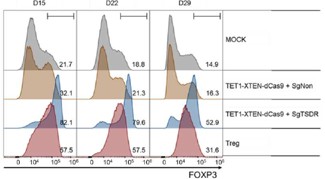
Expression of FOXP3 protein as measured on days 15, 22 and 29 after transfection. Frequency of cells expressing FOXP3 highly is indicated on the side (source: EP25206296.3).
Technology Description
The mRNA-based platform comprises a nucleic acid construct encoding a fusion protein of i) the DNA demethylation-inducing enzyme TET1 and ii) the catalytically impaired RNA-guided endonuclease dCas9, together with iii) one or more sgRNAs targeting the TSDR regulatory sequence of the Treg master transcription factor FOXP3 in primary human CD4+ T-cells. Transient expression of this mRNA-encoded TET1-dCas9 editor robustly induces stable FOXP3 protein expression and a durable immunosuppressive program in both pro-inflammatory naïve and memory CD4+ T-cells, generating epigenetically induced Treg cells with potent suppressive function in vitro and in vivo.
Commercial Opportunity
We are looking for a licensing or/and cooperation partner.
Development Status
Ongoing development currently aims to extend the epigenetic editing platform to iPSCs to achieve their reprogramming independent of TGF-β incubation, into scalable, reliable pools of immunosuppressive Treg cells.
Patent Situation
European patent application EP25206296.3 was filed in October 2025.

Institute of Origin