Filtered Far-UV LED Device for Tissue-safe Antiseptic Decolonisation
Keywords
UVC antiseptic, MRSA/MDR decolonisation, in vivo decontamination, wound disinfection, surgical site infection prevention
Invention Novelty
Researchers at the Ferdinand Braun Institute (FBH) Berlin have developed a far-UV-based antiseptic technology that uses spectrally filtered sub-235 nm LED radiation to decolonise skin, wounds and internal cavities, whilst keeping healthy tissue safe. The device has been assessed at Charité – Universitätsmedizin Berlin for safety of exposure to skin, eyes and mucosa. Conventional UV antiseptic techniques rely on mercury lamps or on gas-discharge/excimer lamps emitting at 254 nm, which induce a large amount of DNA damage in tissue and should therefore not be applied in the presence of humans. Currently, the most common device used to generate far-UVC radiation is a Krypton Chloride (KrCl) excimer lamp, which emits light at the 222 nm wavelength. These sources require elaborate light-guiding, emit considerable heat, and suit only line-of-sight room disinfection. The novelty here lies in a semiconductor DUV-LED whose emission is restricted below 235 nm by an integrated spectral filter element (e.g., an AlOₓ/SiO₂ distributed Bragg reflector), suppressing longer-wavelength, tissue-penetrating components. Combined with an exchangeable optical element (lightpipe, fibre, shaped cap), this uniquely enables cold, geometrically flexible, intracorporeal in vivo antiseptic in cavities previously inaccessible to lamp-based or chemical antiseptic approaches.
Value Proposition
The WHO estimate that 10% of hospitalised patients acquire a healthcare-associated infection, while antimicrobial resistance is linked to 136 million related cases each year. The market is expanding accordingly, moving from legacy systems toward semiconductor emitters, with UVC LED systems projected to see increasing adoption and operating room sterilisation expected to advance with the growing threat of antimicrobial resistance. Because UVC systems address pathogens without adding chemical residue or antimicrobial resistance pressure, the proposed platform's chemical-free, exchangeable-optics design supports diverse use cases, including nasal, pharyngeal, wound, and operation-accompanying decolonisation, offering strong licensing appeal to infection-control device manufacturers seeking mercury-free, tissue-safe differentiation.
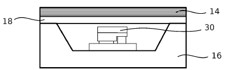
LED chip on its submount, showing the spectral filter element (14), packaging (16), optical element (18) and substrate (30) (source: WO2021043554A1).
Technology Description
The device comprises an LED designed to emit radiation in the UVC spectral range with a spectral filter element configured to restrict the emitted radiation substantially to wavelengths below 235 nm. Typically, a Group III-nitride UV-LED emitting between 210–240 nm is used, with the filter realised as a distributed Bragg reflector. Exchangeable lightpipes or quartz fibres direct radiation into cavities, whilst integrated monitor photodiodes verify delivered dose. The delivered germicidal action damages microbial DNA, while the sub-235 nm wavelengths are absorbed in the skin's horny layer, sparing living epidermis.
Commercial Opportunity
We are looking for a collaboration partner and medical device manufacturer to aid in further product development.
Development Status
The commercialisation-ready technology provides UV emission at different wavelengths for applications ranging from room sterilisation to wound decolonisation. The LED chip can be integrated into various medical devices, including endoscopes. Current optimisation focuses on increasing radiation intensity to reduce sterilisation times from minutes to seconds.
Patent Situation
Granted patents in Europe, US, Canada, Japan and South Korea, originating from PCT application WO 2021/043554 A1 (priority DE102019124017B4 September 2019).

Institute of Origin