First-in-Class S. aureus α-Hemolysin Inhibitors for Lung and Skin Infections
Keywords
Virulence factor, MRSA, HAP, VAP, α-hemolysin, small molecule, inhibitor, pathoblocker
Invention Novelty
First-in-class inhibitors of virulence factor α-hemolysin for the prophylaxis and treatment of lung (HAP/VAP) and skin infections (atopic dermatitis) caused by Staphylococcus aureus.
Value Proposition
- Main target: α-hemolysin (Hla) is the dominant S. aureus virulence factor and a clinically validated target
- Biomarker development: a biomarker is being developed to better stratify VAP/HAP patients to trial size
- Target engagement: Hla inhibitor prevents cytotoxicity in human epithelial cells, as well as NK cells, restores endothelial cells integrity and adherent junctions in primary cultures, and prevents the formation of conduction channels (pore formation)
- Funding: Successful CARB-X, INCATE, and other institutional funding applications
- Highlighting the potential to meet an unmet medical need in Staphylococcus-associated lung and skin infection management.
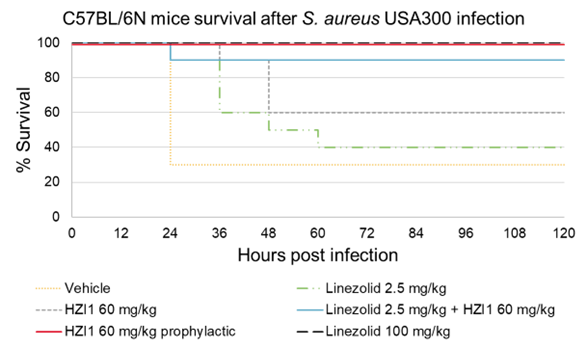
Survival in a mouse model of S.aureus infection (Shekhar et. al., 2025).
Technology Description
- In vitro activity: EC50 = 5-50 nM with negligible cytotoxicity
- Binding activity: ligand pocket identified via NMR
- In vivo activity: Reduction of bacterial lungburden (~3 log units) and plasma IL-6 vs vehicle
- In vivo PoC: Pre-emptive and/or adjunctive treatment with linezolid shows complete recovery of mice with high disease scores
Commercial Opportunity
The technology is available for co-development and in-licensing partnerships.
Development Status
Initiating regulatory preclinical development in VAP and colonized skin lesions in atopic dermatitis.
Patent Situation
Patent family based on WO2023/280970, with subsequent WO2024/133220 as a follow-up application. Applications in the EU, US, CA, JP, and AU are pending.
Further Reading
Original publication – Shekhar et al., 2025. Cell Host & Microbe 33, 4, 560-572
Licensing Contact

Dr Alejandro Restrepo Arango
Technology ScoutT: +49 531 618120-92
restrepo@ascenion.de
Institute of Origin