
Inhibitors of Energy Coupling Factor (ECF) Transporters Against Gram-Positive Pathogens
Keywords
Gram-positive, ECF transporter, Streptococcus pneumoniae, Enterococcus faecium, Enterococcus faecalis, AMR
Invention Novelty
Novel class of antimicrobial agents that specifically target Energy-Coupling Factor (ECF) transporters in Gram-positive bacteria.
Value Proposition
- New MoA: ECF transporters are transmembrane proteins critical for water-soluble vitamins and metal cations uptake, exclusively present in bacteria
- Target engagement: Complete inhibition of folate uptake (ECF transporter) without affecting other transporters such as ABC transporter
- Gram-positive species: Antibacterial profile against S. pneumoniae, E. faecium, E. faecalis, including strains resistant to commonly used antibiotics.
- Excellent safety profile: Less than 10% inhibition on human cell lines at 100 µM ECF transporter inhibitors are highly selective targets to combat infections with clinically relevant Gram-positive bacteria.
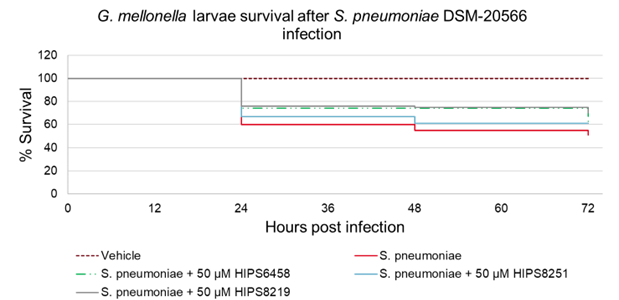
Survival of G. mellonela larvae after infection with S. pneumoniae (modified from Shams et. al., 2024).
Technology Description
- In vitro activity: IC50 = 3.1 µM in whole cell assays and MIC between 0.5 and 4 µM in S. pneumoniae, E. faecium, E. faecalis strains
- In vitro ADME/T: Good half-life (>120 min) and bioavailability with >120 min
- In vivo bioavailability: Constant concentration under IV and PO administration routes
- In vivo PoC: 30% increase in survival in G. mellonela model of S. pneumoniae infection
Commercial Opportunity
The technology is available for co-development and in-licensing partnerships.
Development Status
The project is in lead-optimization stage. Target engagement confirmation, potential for resistance development are being tested.
Patent Situation
A first patent application was filed in November 2023 (EP23210501.5) with a subsequent international PCT (PCT/EP2024/082167)
filed in November 2024. A second patent application was filed in June 2024 (EP24181431.8).
Further Reading
In vivo proof of concept – Shams et al., 2024. Protein Sciences.;33:e5195.
Target identification – Diamanti et al., 2023. Commun Biol 6, 1182.
Licensing Contact

Dr Alejandro Restrepo Arango
Technology ScoutT: +49 531 618120-92
restrepo@ascenion.de
Institute of Origin