
INTERACTEC - A Universal Cytometry‑Based Platform for Directly Mapping Physically Interacting Cells at Ultra‑High Scale
Invention Novelty
Physical interactions between cells orchestrate immunity, development and disease and are the molecular basis of nearly every immunotherapy. Yet existing approaches such as PIC‑seq or reporter‑mouse methods capture them only indirectly, are restricted to pre‑defined cell types, require complex models, and cannot map transient or unknown interactions at scale. InterAcTec applies an automated clustering algorithm to scattering properties (FSC‑ratio distinguishing single cells from multiplets) and cell‑type‑specific surface markers within a single flow‑cytometry dataset, identifying physically interacting cells in an unbiased, data‑driven manner without transcriptome analysis or manual gating, and enabling discovery of previously unknown interactions. In short: InterAcTec does not infer communication, it directly measures physical cell‑cell interactions.
Value Proposition
InterAcTec makes a decisive, previously inaccessible layer of biology directly readable – which cells physically interact, and what that does to them – at a scale and cost no existing method reaches:
Directly measures what others can only infer, characterizing millions of cells and their interactions in minutes. That is orders of magnitude faster and cheaper than single‑cell‑genomics‑based interaction mapping, which captures only up to a few thousand cells.
Runs on standard infrastructure, any conventional or spectral flow cytometer, up to ~50 markers, no specialized reagents. It can even be applied retrospectively to existing cytometry datasets.
Compatible with biobanked patient material (stable upon freeze‑thawing, fixable), enabling large patient‑cohort studies and companion‑diagnostic development for CAR‑T cells and bispecific antibodies.
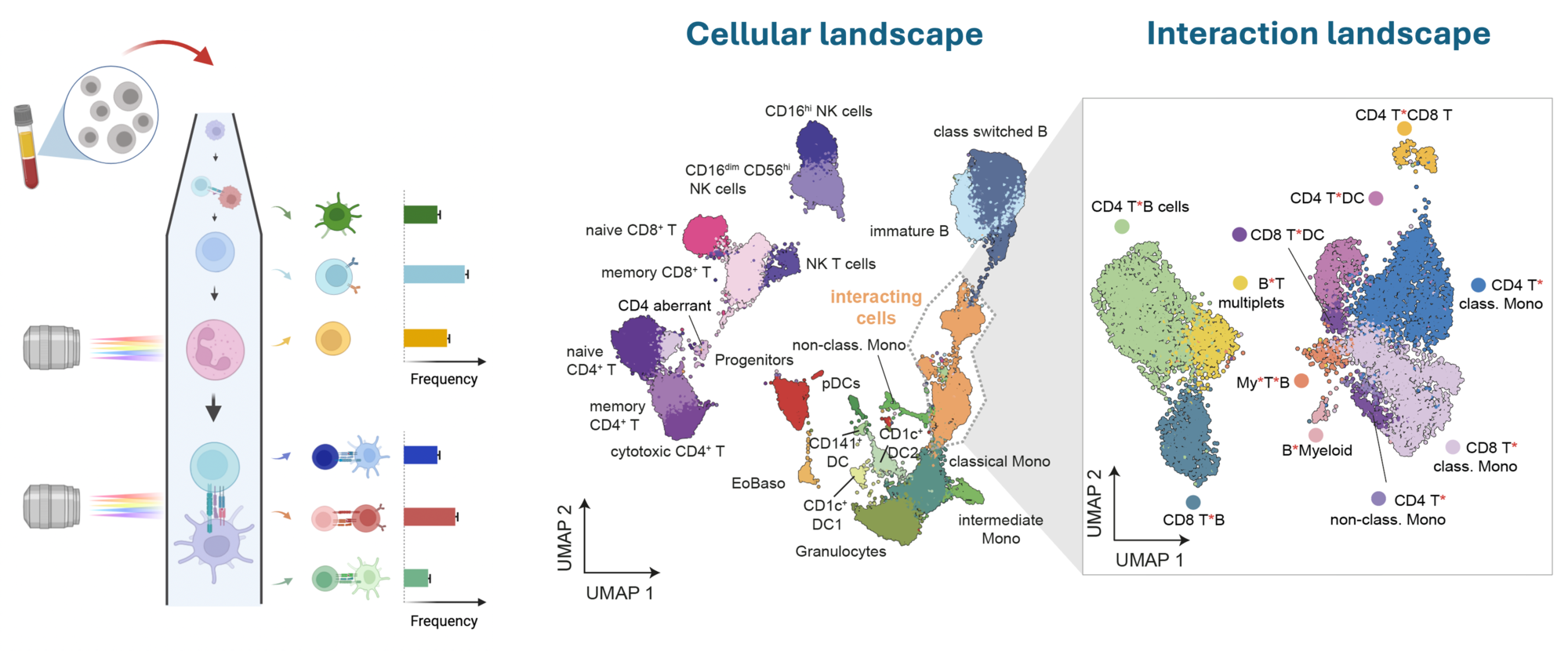
Left: Cells are stained with a defined antibody panel and measured by flow cytometry. Middle: InterAcTec’s proprietary algorithms computationally resolve the cellular landscape of a sample including single cells and cellular interactions (orange cluster). Right: In the next step, the interaction landscape is decoded, and the different cell-cell interactions are quantified.
Technology Description
A cell suspension is stained with a defined antibody panel and analyzed by flow cytometry. Following acquisition, our proprietary computational algorithms cluster events based on similarities in their light-scatter properties and surface marker expression, enabling a comprehensive reconstruction of the cellular landscape that distinguishes single cells from physically interacting cell populations. In a second analytical step, the interaction landscape is resolved in greater detail by identifying and quantifying the cell–cell combinations present in the sample. The resulting interaction map provides a detailed view of the network of physical cell–cell interactions and links each interaction to the phenotypic characteristics of the cells involved.
Commercial Opportunity
Looking for strategic partnership and development partners, with strong fit for pharma/biotech (drug screening and mode‑of‑action studies for bispecific antibodies and CAR‑T/TCR‑T), diagnostic developers (companion diagnostics and personalized response prediction), and instrument/software makers (adding interaction mapping to any cytometer via the PICtR pipeline).
Development Status
Published in Nature Methods, including immunotherapy mode‑of‑action studies, biomarkers of therapy response in relapsed pediatric B‑ALL, organism‑wide in vivo interaction mapping.
Patent Situation
PCT Application (WO 2025/257154 A1) priority2024.
Further Reading
PMID: 40775086.
Licensing Contact

Dr Céline Christiansen-Mensch
Technology ManagerT: +49 (0)1590 4836722
christiansen@ascenion.de
Institute of Origin