Liver Function imaging of the functional hepatic reserve
Invention Novelty
The asialoglycoprotein receptor (ASGR) is a c-type lectin mainly expressed on the basolateral side of hepatocytes, whereas its expression is low in the remainder of the body. This specificity allows for precise targeting of the liver. Non-invasive methods allowing quantitative determination of the functional liver mass are of great interest for patient management in a diversity of clinical settings comprising liver surgery and liver transplantation. In addition, it has been revealed that the evaluation of remnant liver function can help to discriminate different stages of alcoholic liver cirrhosis and could be used to differentiate areas of steatosis, fibrosis and cholestasis. Moreover, control of liver status before and during peptide receptor radionuclide therapy could lead to optimized patient management.
Value Proposition
Despite the good imaging performance of some radiotracers the translation of these molecules into clinical practice is limited due to regulations of biological products isolated from human material. Therefore, particular research interest has arisen in the development of radiolabeled galactose based organic small molecule and glycopeptide radiotracers. The superior stable and long activity retention in hepatic tissue and the pharmacokinetic profile of the new tracers offers a valuable alternative to current approaches and a broader use of these imaging techniques.
Technology Description
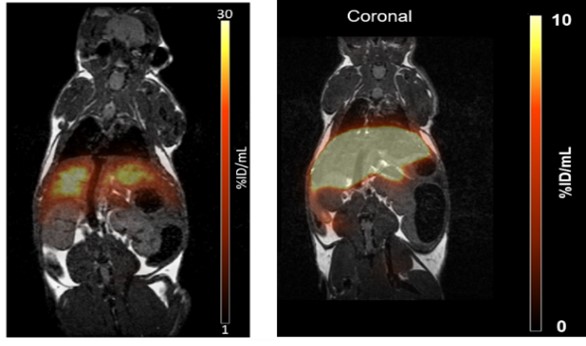
Successfully, 68Ga-labeled linear glycopeptides and Gal/GalNAc trimers have been synthesized and their suitability as imaging agents for the ASGR has been evaluated. Within the tested sets, [68Ga]Ga-NODAGA-NonaLysan and [68Ga]Ga-T3N3 (β-D-N-acetylgalactosamine) were the most potent candidates, exhibiting subnanomolar ASGR affinity, high liver uptake and excellent liver-targeting properties with minimal accumulation in nontarget tissue. Maximum values in liver uptake were already reached 10 min. p.i. while blood activity concentration was very low at that time point. Imaging studies in mice confirmed a rapid elimination from the circulation and allowed for a clear delineation of the functional liver tissue.
Commercial Opportunity
In the US, 4.5 million. cases of diagnosed liver diseases have been reported. The new PET tracers will allow accurate quantification of the tracer dynamics throughout the entire liver enabling to delineate exactly the volumes of interest and move from a rough estimation of liver function to a spatially resolved quantification. The technology is open for co-development or licensing.
Development Status
Preclinical evaluation of both tracers is finished. At the moment, [68Ga]Ga-NODAGA-NonaLysan is prepared for a clinical study.
Patent Situation
Small molecule radiotracers: Pending in US and EP (priority: 2022); Peptide-based radiotracers: PCT filed (priority: 2024)
Further Reading
Zierke et al. (2025), Mol. Pharm. 22:1677-1685; Zierke et al (2024), J. Med. Chem. 67:19668-19677; Zierke et al. (2024), EJMMI Radiopharm. Chem. 9:41

Institute of Origin