Method for tuning brain network models for the implementation of brain digital twins
Keywords
brain network models, brain digital twin, functional MRI, feedforward inhibition
Invention Novelty
Researchers of Berlin Institute of Health at Charité, Universitätsmedizin Berlin, have established a method for tuning brain network models (BNMs) that considerably improves personalized BNMs generated from non-invasive measurements such as functional MRI data. Such improved personalized BNMs closely reflect the empirically measured functional interactions between brain areas as a result of the proposed new fitting scheme. This paves the way towards the implementation of personalized brain digital twins.
Value Proposition
The technology presents a method that allows to establish personalized BNMs and to determine simulated activation currents. Many neurological disorders affect the brain and might be related to unphysiological stimulus transmission within the central nervous system. Therefore, a personalized brain simulation has the potential to help estimate the influence of e.g. an interventional stimulus to a patient’s brain in silico. This may ultimately support the assessment of therapy options for patients suffering from neurological disorders.
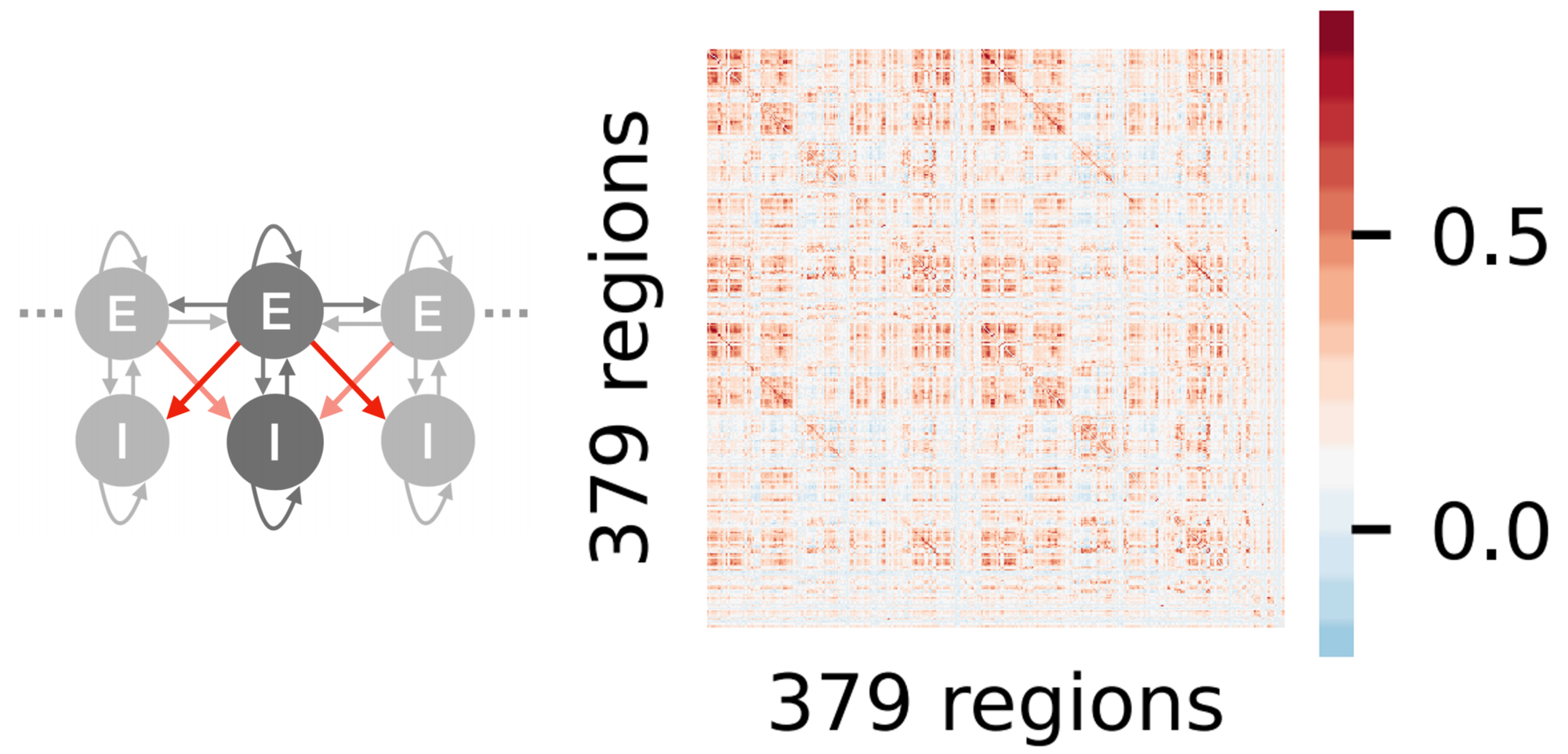
Left: For tuning BNMs, long-range white matter couplings between every pair of BNM nodes have been taken into consideration.
Right: Empirical (here: functional MRI-based; upper triangular portion of the matrix) versus simulated (lower triangular portion of the matrix) functional connectivity matrix, representing the interaction of each pair of brain regions. Full similarity has been achieved by systematically tuning long-range excitory and inhibitory synaptic inputs and especially by taking couplings from excitory to inhibitory populations into consideration.
Taken from Schirner M., et al., Creative Commons Attribution 4.0 international license.
Technology Description
The technology makes use of the observation that for simulation purposes, the empirical interaction between every pair of brain areas can be systematically tuned with the appropriate long-range excitation-inhibition balance and proposes model fitting with a parameter learning algorithm.
Commercial Opportunity
The technology is available for in-licensing.
Development Status
A proof of principle with regard to the BNMs has been shown.
Patent Situation
A priority establishing patent application, and an international patent application have been filed (Tuning a Biological Network Model, EP4443442 and WO2024208887).
Further Reading
A study which includes the method described above has been published (Schirner M, et al., Learning how network structure shapes decision-making for bio-inspired computing, Nature Communications 2023, 14:2963).

Institute of Origin