
Modular Nanoparticle Platform for Solution-Phase Optical Sensing of Protein-Protein Interactions
Keywords
Nanosensors, protein-protein interaction, binding constants, association/dissociation rates, nanoparticles, UV-vis spectrophotometry
Invention Novelty
The present invention provides novel functionalized metal nanoparticles that act as optical biosensors for the label-free quantification of protein-protein interactions in dispersion. While prior efforts to exploit localized surface plasmon resonances (LSPRs) of nanoparticles in liquid suspension have been limited to lipid–protein interactions, this invention extends the approach to protein-protein interactions for the first time. Its core novelty lies in the use of gold-coated silver decahedral nanoparticles whose thin gold shell confers chemical stability and biocompatibility in biological buffers while preserving excellent optical sensing properties.
Value Proposition
The protein-assay space is a substantial market spanning kits, reagents, and instruments, with applications in drug discovery and disease diagnosis and end users including pharmaceutical and biotechnology companies. Established methods for studying protein-protein interactions - such as surface plasmon resonance (SPR), isothermal titration calorimetry (ITC), or fluorescence-based techniques - involve dye modification, cost-intensive instruments, or complex microfluidic processes, and mostly require large amounts of protein sample. The invention's key commercial advantage is thus its accessibility, simplicity, and cost-effectiveness: it demands little protein sample and avoids amino-acid modification, immobilization on planar sensor surfaces, and costly or complex instrumentation, relying instead on UV-vis spectrophotometry, equipment common to most laboratories. Its modularity across binding pairs broadens use cases and makes it well suited for licensing to assay and reagent manufacturers.
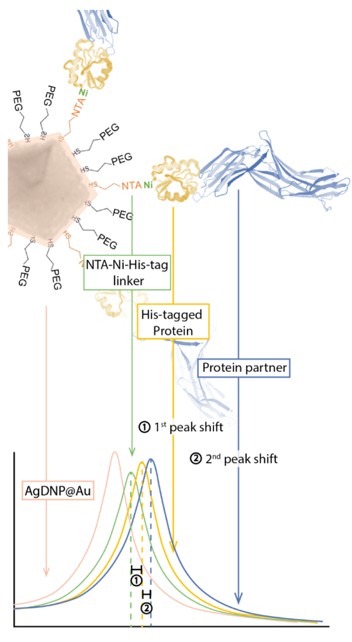
Modular nanoparticle platform; Zhou et al., ACS Appl. Opt. Mater. (2025)
Technology Description
The technology comprises gold-coated silver decahedral nanoparticles that serve, in dispersion, as optical nanosensors for protein-protein interactions. When excited by UV-vis photons, the nanoparticles undergo a collective electronic oscillation (localized surface plasmon resonance) whose specific absorption shifts upon molecular binding. The nanoparticle surface is functionalized with an mPEG-SH stabilizing ligand and an NTA-Ni linker, enabling specific capture of a first polyhistidine-tagged recombinant protein; its binding partner is then added to the suspension. Each binding event between the nanoparticle-immobilized polyhistidine-tagged protein and its interacting partner in solution produces a distinct spectral shift of the plasmon resonance, which can be monitored by conventional UV-vis spectrophotometry. From these shifts, binding constants as well as association and dissociation rates are determined.
Commercial Opportunity
The technology is available for in-licensing and co-development.
Development Status
Proof-of-concept has been successfully demonstrated with two well-characterized interaction pairs (TAD-NCBD and PEX5-PEX14), yielding binding affinities and association/dissociation kinetics consistent with published values.
Patent Situation
International PCT application WO2025119705A1 has been published.
Further Reading
Jieying Zhou, Korneel Ridderbeek, Peijian Zou, Aaron B. Naden, Stefan Gaussmann, Fangyuan Song, Pascal Falter-Braun, Euan R. Kay, Michael Sattler, Jian Cui; Modular Nanoparticle Platform for Solution-Phase Optical Sensing of Protein–Protein Interactions. ACS Appl. Opt. Mater. 28 March 2025; 3 (3): 676–688.

Institute of Origin