Non-Teratogenic Induced Multipotent Neuromesodermal Stem Cells (iMNMSCs) for Regenerative Cell Therapy
Invention Novelty
Direct reprogramming method for generating induced multipotent neuromesodermal stem cells (iMNMSCs) from human somatic cells by expression of three reprogramming factors (OCT4, SOX2 and KLF4 or TBXT). iMNMSCs open up new prospects for the development of regenerative cell-based therapies without the risk of teratoma formation. iMNMSCs therefore represent a safe alternative to iPSC-derived cell and tissue products and offer new treatment options, for example for spinal cord injuries, muscular dystrophies or chondropathies.
Value Proposition
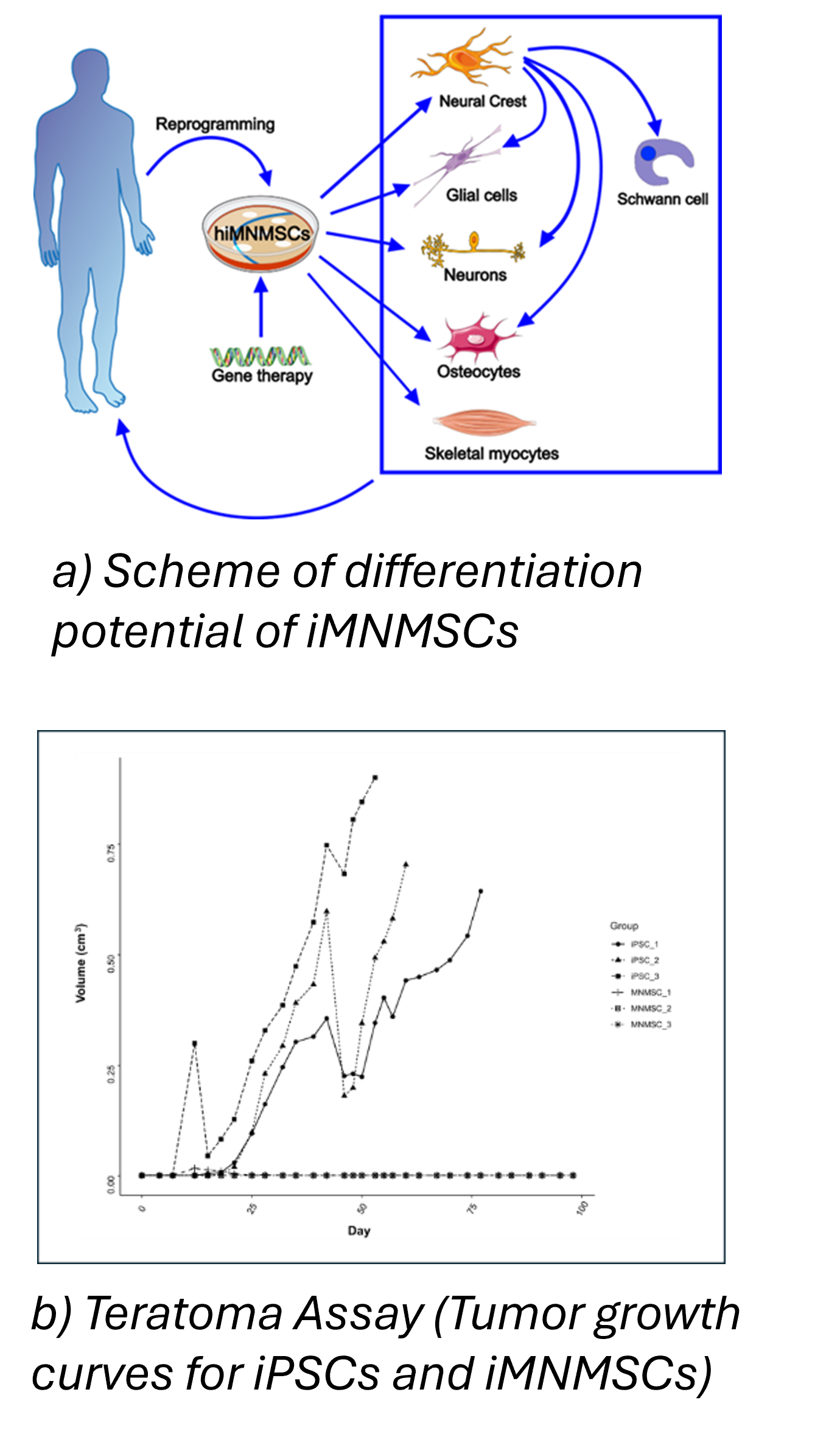
Human iMNMSCs are stable cell lines with neural and mesodermal differentiation potential that are generated by direct reprogramming of human adult somatic cells and do not pass a pluripotency state. These multipotent cells can proliferate indefinitely in culture, and differentiate into neural and mesodermal lineages (bone, cartilage, muscle) giving rise to a variety of cell types and tissues for regenerative therapies [Fig. a)].
Technology Description
hiMNMSCs are generated by a combination of OCT4, SOX2 and TBXT or KLF4. Around day 25-27 TBXT/SOX2-positive colonies emerge which can be expanded yielding stable, indefinitely proliferating iMNMSC lines without pluripotency features. Single cell RNA-seq revealed no OCT4 or NANOG-positive cells, also transient pluripotency was excluded by single cell analysis of multiple time points during reprogramming of fibroblasts to iMNMSCs. In addition, it was demonstrated that OCT4A and NANOG promoters were hypermethylated and silenced. Accordingly, in contrast to iPSCs, no teratomas were formed in immunodeficient mice, even after 100 days post-implantation [Fig b)]. Further, molecular karyotyping of iMNMSCs demonstrated stable karyotypes.
Commercial Opportunity
The technology is offered for licensing and collaborative approaches in the field of regenerative therapies (e.g., for the treatment of spinal cord injury, neuropathies or peripheral nerve injury, muscular dystrophies or chondropathies).
Development Status
The protocol for generation of hiMNMSCs was established and validated using samples of healthy and diseased donors, and hiMNMSCs have been extensively characterized with regard to their suitability for therapeutic purposes.
Patent Situation
A priority establishing European patent application was filed in May 2025 followed by a PCT application (PCT/EP2026/063819).
Further Reading
Manuscript in preparation.

Institute of Origin