
Novel ASO-Based mRNA Silencing Technology for Phage-Host Interaction Research
Keywords
Antisense Oligomers (ASOs), Phage-Host Interactions, mRNA Silencing, Jumbo Phage ΦKZ, Non-GMO, Phage Therapy
Invention Novelty
This technology offers a novel, non-genetic method for silencing mRNA in bacteriophages using antisense oligomers (ASOs). It enables the functional characterization of essential genes in both DNA and RNA phages, including the jumbo phage ΦKZ, which infects Pseudomonas aeruginosa. This is the first time ASO-based gene silencing has been applied to study such complex phage-host interactions. ASO uptake is stimulated by a cell penetrating peptide (CPP) attached to the ASO.
Value Proposition
The ASO-based approach is versatile and can be applied to various phages and bacterial hosts, overcoming limitations of traditional genetic methods. It is a non-GMO technology, making it suitable for use in regulated environments. It will be useful in industrial applications, for example, where fermentation processes need to be protected from phage contamination. Additionally, it has potential applications in optimizing phage therapy, offering a new way to enhance treatments against multidrug-resistant bacterial infections.
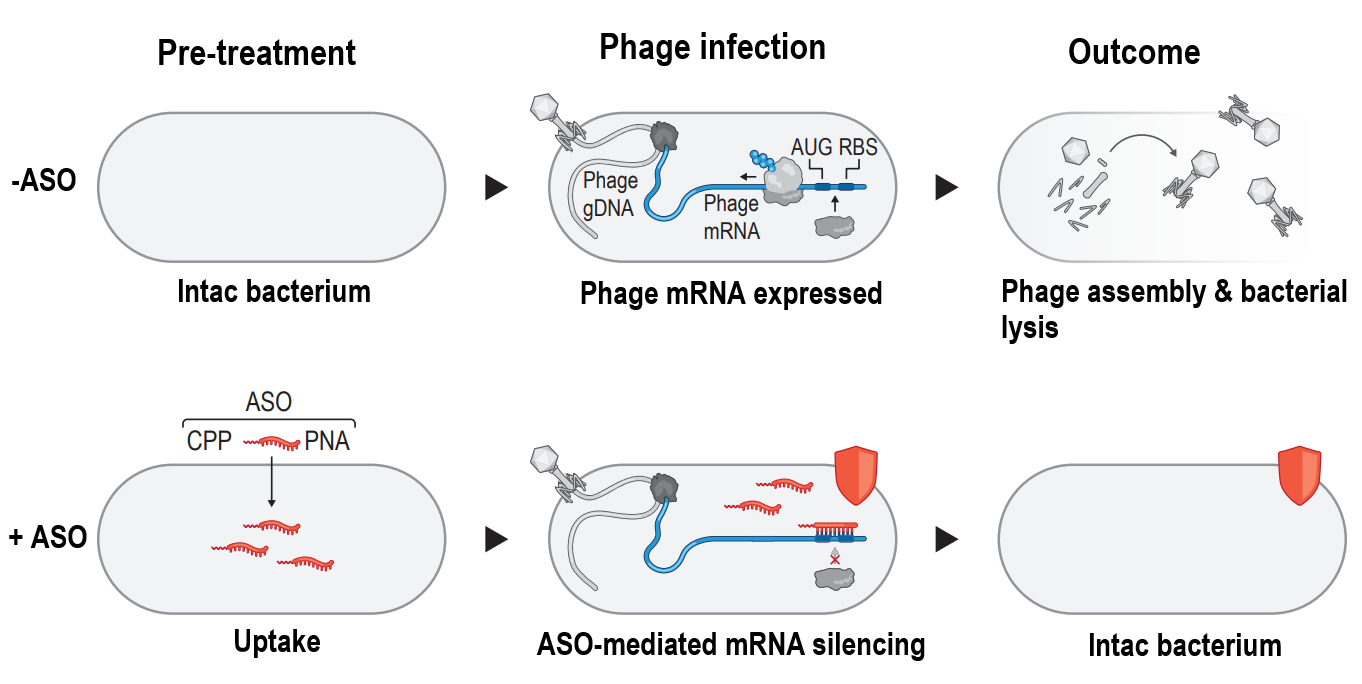
Antisense oligomers (ASO) are taken up by the bacterial cell mediated by cell penetrating peptides (CPPs). After phage infection, ASOs bind specific phage transcripts and prevent translation. If the protein encoded by the target phage mRNA is essential for phage propagation, no phage progeny is formed. PNA, peptide nucleic acid.
© Helmholtz-Zentrum für Infektionsforschung
Technology Description
This technology employs programmable ASOs to target specific mRNA sequences in phages, preventing the production of essential proteins. Successful experiments with the ΦKZ phage demonstrated the ability to identify and silence key genes, revealing new insights into phage biology and host-pathogen interactions. The method is also effective in studying host defense systems, even in genetically intractable strains.
Furthermore, repressing of repressors of lytic phages is a possible application. This leads to the production of large numbers of lytic phages, which cause lysis of the bacterial host and could therefore be used to treat infected patients.
In addition, phage production for biotechnological processes can be optimized by the repression of repressors.
Commercial Opportunity
The technology has broad commercial potential in phage therapy, biotechnology research, pharmaceutical applications, and industrial processes. The technology is available for in-licensing and co-development.
Development Status
Currently, the technology is at the experimental validation stage, with successful proof-of-concept studies completed. Further development is needed to optimize ASO delivery and expand its application.
Patent Situation
A European patent application was filed in July 2024.
Further Reading
M Gerovac et al., Non-genetic messenger RNA silencing reveals essential genes in phage-host interplay. bioRxiv 2024.07.31.605949; doi: https://doi.org/10.1101/2024.07.31.605949. Gerovac, M., Buhlmann, L., Zhu, Y. et al. Programmable antisense oligomers for phage functional genomics. Nature (2025). https://doi.org/10.1038/s41586-025-09499-6

Institute of Origin