Novel CARs for the Treatment of Multiple Sclerosis and Alzheimer´s Disease
Keywords
Chimeric Antigen Receptor, Multiple Sclerosis, Alzheimer’s Disease, Regulatory T-cells
Invention Novelty
The invention introduces novel Chimeric Antigen Receptors (CARs) that are expressed in regulatory T-cells (Tregs) and enable targeted immunosuppression within the central nervous system. These CARs are uniquely specific to myelin basic protein (MBP) or myelin oligodendrocyte glycoprotein (MOG), which are known antigens in the autoimmune pathology of neuroinflammatory diseases, such as multiple sclerosis (MS) and Alzheimer’s disease (AD). Therefore, the invention enables a targeted therapy of these neuroinflammatory diseases without compromising surrounding tissues.
Value Proposition
The technology provides an immunotherapeutic strategy for treating autoimmune neuroinflammatory diseases with a focus on MS and AD. Engineered Tregs with antigen-specific CARs targeting MBP or MOG ensure localized immunosuppression specifically within the brain and spinal cord. A major value lies in the ability of Tregs to migrate naturally to diseased neuronal tissues, including migrating across the blood-brain barrier, allowing for systemic administration while achieving localized effects. Furthermore, a built-in safety marker provides the capacity for selective cell deletion, addressing a critical safety concern in cell-based therapies.
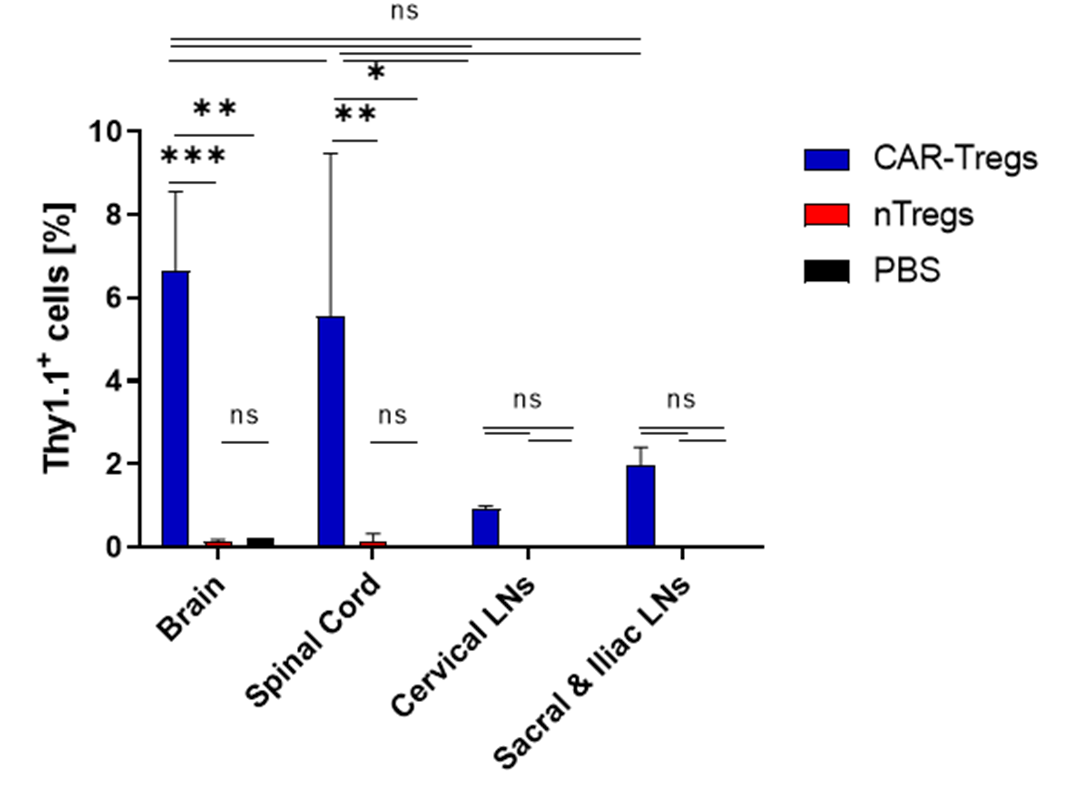
Treg cells expressing a MBP-specific CAR are mainly detectable in brain and spinal cord.
Technology Description
The described technology consists of modified Tregs that express CARs targeting either MBP or MOG. The characteristic single chain variable fragments (scFvs) were derived via phage display for high affinity to MBP or MOG and fused to intracellular signaling domains (CD28 and CD3ζ). Further, the CAR is co-expressed with FOXP3 to ensure the regulatory phenotype of Tregs, and optionally coupled to a safety marker (deltaLNGFR). Tregs are derived from autologous T-cells and genetically modified to express the CAR. In vitro and in vivo studies showed target-specific activation of novel CAR-Tregs and high specificity to CNS tissue in a disease-related mouse model. In summary, the technology enables an antigen-specific therapeutic approach with a clear potential to restore immune tolerance in neuroinflammatory autoimmune disorders without broad immunosuppression.
Commercial Opportunity
In-licensing is possible.
Development Status
In vitro and in vivo studies have successfully demonstrated proof of concept of the novel technology.
Patent Situation
European and US patent application (based on WO 2025/040799) with priority of 2023 are pending.
Further Reading
Saetzler V, Riet T, Schienke A, Henschel P, Freitag K, Haake A, Heppner FL, Buitrago-Molina LE, Noyan F, Jaeckel E, Hardtke-Wolenski M. 2023. Development of Beta-Amyloid-Specific CAR-Tregs for the Treatment of Alzheimer's Disease. Cells. 12(16):2115. doi: 10.3390/cells12162115.

Institute of Origin