
Novel Diagnostic Marker For Early Detection Of Bladder Cancer
Keywords
Bladder cancer, glycan, diagnostic marker, tumorspecific, antigen
Invention Novelty
Researchers from Hannover Medical School identified a strong prognostic value of the glycan Neolactotetraosylceramide (nLc4) for the detection of bladder cancer.
Value Proposition
Bladder cancer is a life-threatening disease and the chances for curative treatment are strongly depending on the time-point of diagnosis. Unfortunately, current options for diagnosing bladder cancer are very limited and are mainly restricted to invasive procedures. In contrast, the identified tumor-specific glycan can be easily detected in patient’s urine e.g. during preventive medical check-ups and allow for an early, non-invasive diagnosis of bladder cancer.
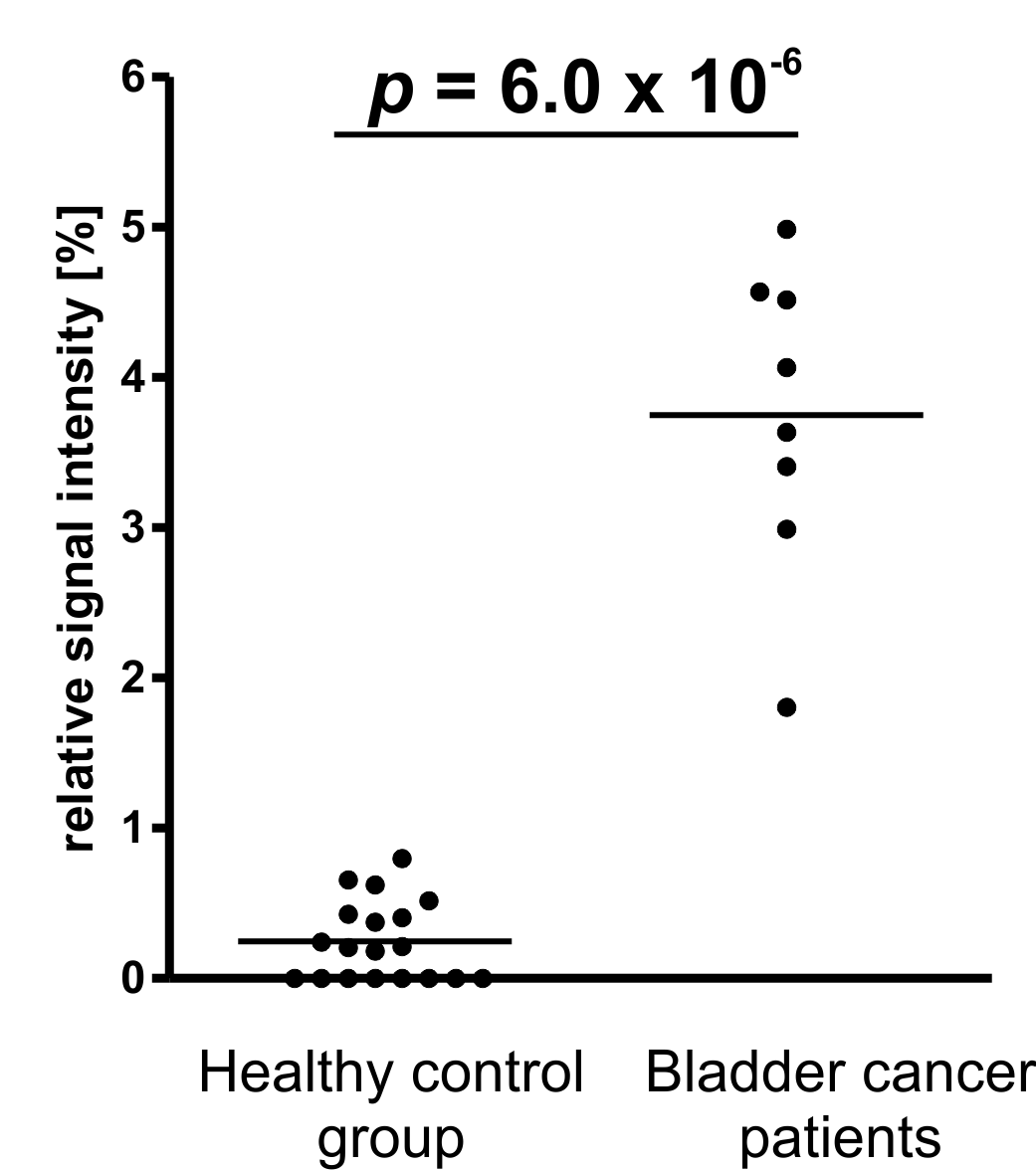
Novel marker nLc4 is significantly enriched in bladder cancer patients.
Technology Description
Glycosphingolipids have been shown to be suitable markers for different malignant diseases but identification and quantitative measurement of single glycosylation patterns is very complex and not suitable for standard diagnostic tests. Therefore, a novel analytic method was developed, allowing for quantitative detection of glycans after hydrolysis of the respective glycosphingolipids. Using the novel method a glycan, nLc4, was identified to be significantly enriched in urine samples of bladder cancer patients compared to healthy individuals. Due to a significantly increase of this glycan between 5 to 10 times above normal, healthy values, the identified glycan represents a novel marker for early and reliable detection of bladder cancer.
Commercial Opportunity
In-licensing or collaboration for further development is possible.
Development Status
The novel marker has been successfully validated in proof-of-concept studies with urine samples from bladder cancer patients and healthy individuals. An antibody-based detection is currently being developed.
Patent Situation
European patent has been granted (EP 4004550, with priority of 2019).
Further Reading
Moreira IB, Rossdam C, Bräsen JH, Tezval H, Buettner FFR et al. 2025. Neolactotetraosylceramide enables urinary detection of bladder cancer. Cell Rep Med. 18:102246. doi: 10.1016/j.xcrm.2025.102246.
Moreira IB, Rossdam C, Beimdiek J, Vicente MM, Schmitz J, Oberbeck A, Bräsen JH, Tezval H, Buettner FFR. 2023. Neolactotetraosylceramide: A novel non-invasive urinary biomarker for bladder cancer doi.org/10.1101/2023.08.08.552442
Rossdam C, Konze SA, Oberbeck A, Rapp E, Buettner FFR et al. 2019. Approach for Profiling of Glycosphingolipid Glycosylation by Multiplexed Capillary Gel Electrophoresis Coupled to Laser-Induced Fluorescence Detection To Identify Cell-Surface Markers of Human Pluripotent Stem Cells and Derived Cardiomyocytes. Anal Chem. 91(10):6413-6418. doi: 10.1021/acs.analchem.9b01114.

Institute of Origin