
Novel inhibitors of Cytomegalovirus
Keywords
small molecule, first-in-class, CMV, hCMV, solid organ transplantation, SOT, hematopoietic stem cell transplantation, HSCT
Invention Novelty
First-in-class, small-molecule inhibitors targeting cytomegalovirus (CMV) with a novel structure and mechanism of action. The technology is particularly effective against human CMV infections that are resistant to existing antiviral drugs, offering an innovative antiviral solution for hematopoietic stem cell transplantation and solid organ transplant recipients.
Value Proposition
CMV infections are widespread and pose severe risks for immunocompromised individuals, such as transplant recipients and newborns. Current treatments are often limited by significant side effects and drug resistance. This invention addresses these
challenges with:
- High Potency: EC50 < 10 nM, surpassing Letermovir in efficacy
- Resistance-Breaking Ability: Effective against Letermovir- and Ganciclovir-resistant strains
- Targeted Action: Novel mechanism halts DNA capsid formation via the AHP binding site in the terminase complex
- Selective Activity: Inactive against non-target viruses (murine CMV, herpes simplex, and adenovirus)
These features highlight the potential to meet an unmet medical need in CMV management.
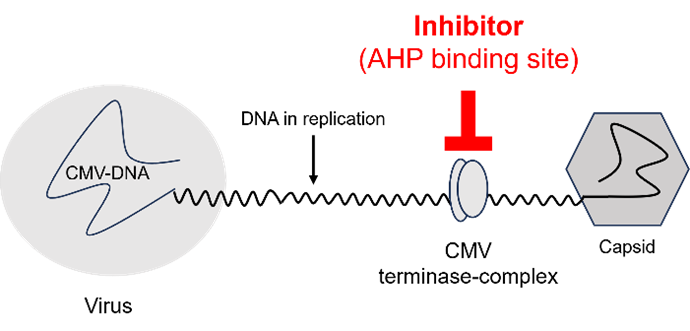
Mechanism and binding site to inhibit human cytomegalovirus (HCMV) infection (Unpublished)
Technology Description
- Novel Structure: Unique molecular design with a new mechanism of action that inhibits the AHP binding site of the CMV terminase complex
- Low Toxicity: Favorable ADME/Tox profiles demonstrated in vitro
- Scalable Production: Cost-effective synthesis for broader commercial viability
Commercial Opportunity
The technology is available for co-development and in-licensing partnerships.
Development Status
Comprehensive in vitro ADME/Tox data and pharmacokinetic data from a mouse model are available.
Patent Situation
PCT application was filed in February 2024 (WO2024170639) and another European priority application was filed in August 2024 (EP24 194 624.3).
Further Reading
Indication proof of concept – Khawaja et al. 2023. Clin Microbiol Infect. 2023 29(1).
Licensing Contact

Dr Alejandro Restrepo Arango
Technology ScoutT: +49 531 618120-92
restrepo@ascenion.de
Institute of Origin