Oral Antimotilin-Based Inhibitors for Treating Helicobacter pylori Infections
Keywords
Gastric cancer, Helicobacter pylori infections, anti-virulence therapy, Bacterial motility inhibition, Antimotilins
Invention Novelty
Novel small molecules that specifically inhibit the motility-associated functions of H. pylori and allow for treating stomach infections.
Value Proposition
- New MoA: “Antimotilins” selectively block H. pylori flagellar biosynthesis/motility, an essential colonization trait
- Target engagement: decreased flaA transcription and flagellin A protein; rapid reduction of swimming speed in live tracking at 10 μg/mL; flaA-luciferase reporter IC₅₀ ≈ 2.7 μg/mL
- In vivo proof-of-concept & safety: oral Active2 (10 mg/kg/day × 7) significantly lowered gastric (antrum) H. pylori CFUs and reduced cagL DNA rapidly without observed toxicity up to 60 mg/kg/day; no increased gastric pathology
- Microbiota-sparing & selectivity: minimal activity on E. coli, C. jejuni, P. aeruginosa, S. aureus; fecal microbiota composition and diversity unchanged after in vivo treatment
Active2 is a low-resistance-pressure option for mono or combo therapy that disables H. pylori flagellar motility to remove gastric colonization in vivo while sparing the microbiome.
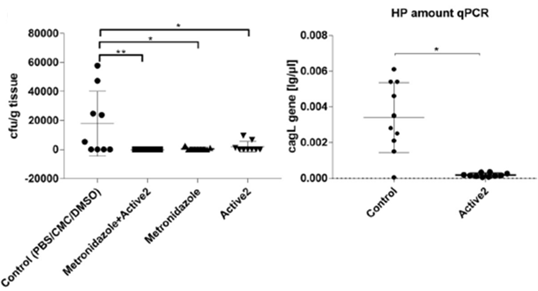
Active2 compound reduces colonization in a H. pylori mouse model, shown with CFU (left) and gene expression (right) from stomach corpus samples (modified from Suerbaum et. al., 2022).
Technology Description
-Screening platform: Enables multi-well HTS with ~4,000 compounds screened across 4 libraries, with only ~1% with anti-flagellar activity without growth inhibition
-In vitro activity: IC₅₀: 2.6 μg/mL without antibacterial effect (MIC ≥ 32 μg/mL); reduces curvilinear velocity at 10 μg/mL; lowers flaA mRNA and surface flagellin A protein; good aqueous solubility
-In vivo regimen & efficacy: Once-daily oral Active2 drives corpus cagL qPCR signals toward the detection limit compared to metronidazole, which leaves a residual qPCR signal
-Safety/TD: maximum-tolerated dose ≥ 60 mg/kg/day with no toxicity; plasma cytokines unchanged; no added gastric pathology; intestinal microbiota unaffected post-treatment
Commercial Opportunity
The technology is available for co-development and in-licensing partnerships.
Development Status
The project is in an early hit-to-lead stage. One water-soluble compound has been used for a PoC in mice (oral administration).
Patent Situation
A European patent was granted (EP3892734B1) with validity in 18 member states, as well as CH, GB, and ES.
Further Reading
Original publication – Suerbaum et al., 2022. mBio. 13:e03755-21.
Licensing Contact

Dr Alejandro Restrepo Arango
Technology ScoutT: +49 531 618120-92
restrepo@ascenion.de
Institute of Origin