
Prediction for targeting efficiency of guide RNA for a gene of interest in bacteria
Keywords
gene silencing, guide efficiency, Cas9, CRISPRi, software, predictive model, machine learning, AI
Invention Novelty
Provided is a machine learning-based tool that improves reliable prediction of targeting efficiency of guide RNA for gene silencing in bacteria.
Value Proposition
CRISPR interference (CRISPRi) technology is used to block gene expression with a catalytically inactive mutant of Cas9 (dCas9).
This requires a short guide-RNA to target dCas9 to the gene of interest, where it binds and blocks transcription, thus leading to gene silencing. In general, gene silencing is not complete, and silencing efficiency is affected by several factors, such as basal gene expression. Available machine learning-based tools for prediction fail to account for gene-specific factors that could influence guide depletion during training, such as their transcriptional activity or operon structures. In contrast, the offered innovative and
robust methods to produce predictive models for guide efficiency represents an important tool to increase efficacy in a cost-effective way.
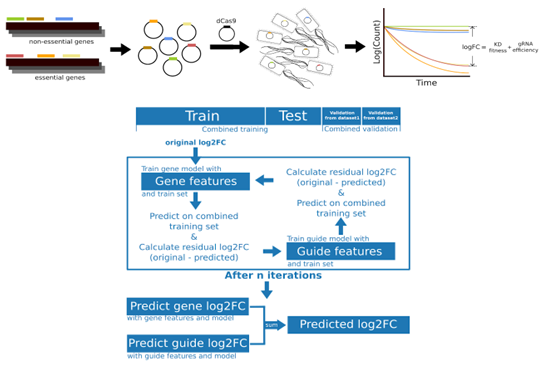
Workflow of prediction of guide efficiency [Yu et al. 2022, modified]
Technology Description
The invention relates to a method for prediction of the
targeting efficiency of guide RNA (gRNA) for gene
targeting by evaluating data obtained in genome-wide
screens. , which provide levels of targeting
characteristics efficiency of guides including levels of
targeting efficiency confounded with gene specific
effects. The method is based on a mixed-effect
random forest regression model that can learn from
multiple datasets and isolates effects manipulable in
guide design, combined with methods from
explainable AI to infer interpretable design rules.
Commercial Opportunity
Enabling technology for basic research as well as for applied biotechnology by enabling precision modification of the bacterial
transcriptome. The technology is offered for licensing.
Development Status
The workflow is provided as a software implementation that can be applied to any bacterium for which a genome wide CRISPRi
screen is available. In addition, a model to predict the guide efficiency of dCas9 has been implemented in E. coli, including a
webserver, and a command-line tool is available.
Patent Situation
Priority application filed July 2020; PCT WO 2022/013186 published 2022; European patent granted 2023; US application pending.
Further Reading
Yu et al. 2022. bioRxiv preprint: doi.org/10.1101/2022.05.27.493707
Licensing Contact

Dr Alejandro Restrepo Arango
Technology ScoutT: +49 531 618120-92
restrepo@ascenion.de
Institute of Origin