
Single-Step Biocatalytic Production of L-Carnitine from Glycine Betaine
Keywords
L-carnitine, glycine betaine, PKS-NRPS hybrid enzyme, biocatalysis, enantioselective synthesis
Invention Novelty
Existing routes to L-carnitine each carry inherent constraints. Chemical syntheses generally yield a racemate, which must subsequently be resolved into its enantiomers, entailing multiple steps, the use of organic solvents, and the handling of a permanently charged product. Microbial routes rely either on the cai operon — a set of genes for the interconversion of crotonobetaine and related substrates — or on γ-butyrobetaine dioxygenase (GBBD), an enzyme that hydroxylates γ-butyrobetaine to carnitine, and are respectively constrained by the complexity of that operon and its feedback regulation, and by the dependence of the GBBD route on the availability of γ-butyrobetaine. The present invention introduces a biosynthetically distinct third route based on a PKS–NRPS hybrid enzyme — a combined polyketide synthase and non-ribosomal peptide synthetase enzyme complex. This hybrid possesses an adenylation domain that accepts glycine betaine as substrate and assembles carnitine therefrom, among the first reported instances of an adenylation domain accepting glycine betaine as a substrate.
Value Proposition
The technology targets the growing, sustainability-driven market for high-purity L-carnitine used in supplements, clinical nutrition and animal feed, where fermentation-based bioprocesses are increasingly favoured over chemical synthesis. Its key advantage is operational simplicity and enantioselectivity: the pathway is complementary to previously known routes and provides L-carnitine in a single enzymatic conversion from glycine betaine, a cheap, commercially available substrate that is, in established production hosts, also intrinsically provided. Because the route avoids racemate resolution and the feedback-regulated cai operon, it simplifies process design and downstream purification. This positions the technology for licensing in green fine-chemical and nutraceutical manufacturing.
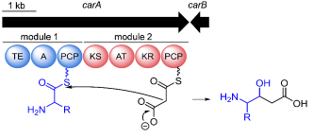
Above: Domain architecture of CarA with module 1 (TE-A-PCP) and module 2 (KS-AT-KR-PCP); below: assembly of the carnitine skeleton from glycine betaine and a malonyl-derived extender unit. Copyright HZI.
Technology Description
The method converts glycine betaine into L-carnitine through an NRPS/PKS-based pathway centred on the CarA enzyme. The conversion is catalysed by a single multienzyme system comprising the following domains: thioesterase, adenylation, peptidyl-carrier protein, ketosynthase, acyltransferase and ketoreductase. The reference cluster derives from a Gram-negative bacterium and requires the cognate phosphopantetheinyl transferase CarB. Heterologous production of L-carnitine in Escherichia coli and in Pseudomonas protegens demonstrates that the conversion is feasible in different hosts, paving the way for increased yield through host and process optimisation.
Commercial Opportunity
Available for in-licensing and co-development.
Development Status
Proof of concept established: the pathway has been functionally demonstrated by heterologous expression in E. coli and P. protegens, with the product confirmed as L-carnitine; strain and process optimisation are pending.
Patent Situation
An EP-Application was filed in August 2026.

Institute of Origin