
The Prognostic Umbilical Swab: A Rapid Molecular Risk Stratification Tool for Neonatal Sepsis and Brain Injury
Invention Novelty
This technology introduces the first non-invasive, prognostic biomarker derived from the umbilical cord that surpasses the current gold standard – blood culture – in predicting fatal early-onset sepsis (EOS) and severe intraventricular hemorrhage (IVH). Unlike conventional diagnostic blood tests, which often fail due to limited blood volume and low pathogen load in neonates, this method targets the endothelial reservoir of the umbilical vein. By employing quantitative PCR (qPCR) to detect pathogen DNA accumulation, it provides a direct correlation with clinical severity and neurological outcomes.
Value Proposition
The prognostic umbilical swab offers superior sensitivity, detecting 37% of sepsis-related deaths within the first week of life – compared to 23% for blood culture – and 10.5% of severe IVH cases, as opposed to just 1.8% detected by blood culture. Its strong prognostic power is evident: a positive PCR result with a low Cq value (≤32) reflects a high pathogen load and serves as a robust predictor of mortality (odds ratio [OR] 10.8 for death) and severe brain injury (OR 3.2 for IVH Grade IV in culture-negative infants). While the assay has so far been validated using standard laboratory-based qPCR, development towards a rapid, point-of-care format – using a non-invasive umbilical vein swab and providing results in under 60 minutes – is underway. Furthermore, the biomarker provides actionable insights, with a negative predictive value (NPV) exceeding 99.9% for mortality, enabling clinicians to confidently rule out severe disease courses, reduce unnecessary antibiotic exposure, and efficiently stratify high-risk infants for neuroprotective interventions.
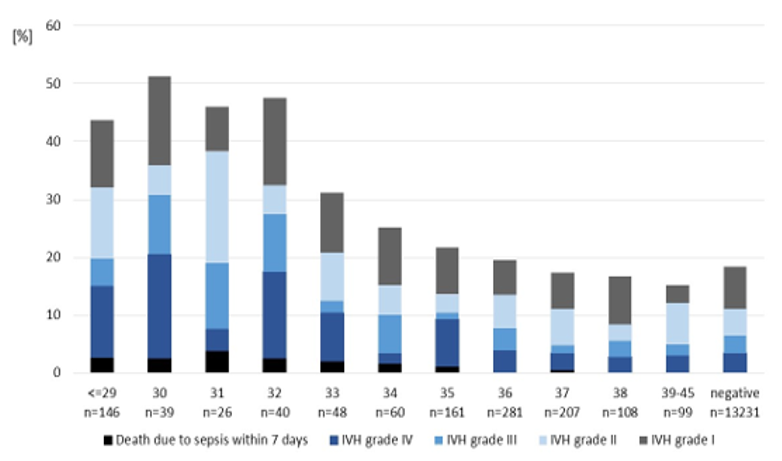
Cq values for Enterobacteriaceae or GBS PCR and outcome of preterm infants. Each infant was categorized to the lowest Cq-value in both qPCR (Goepel et al., unpublished).
Technology Description
At the core of the invention is a method for detecting DNA from Enterobacteriaceae (such as E. coli and Klebsiella) and Group B Streptococci (GBS) within endothelial cells of the umbilical vein. Retrospective validation has demonstrated that pathogens accumulate in this tissue compartment even when blood cultures remain negative – a phenomenon known as "culture-negative sepsis." The assay leverages specific qPCR targets and a validated Cq-cutoff algorithm to reliably distinguish between mere colonization (high Cq) and invasive, high-risk infection (low Cq).
Commercial Opportunity
The global market for this test is estimated at 1–2 million tests annually for preterm and high-risk term infants. The prognostic umbilical swab represents an ideal "front-door" screening tool for neonatal intensive care units (NICUs), complementing existing pathogen identification panels (such as BioFire and GeneXpert) by acting as a rapid triage solution. Economically, the technology has the potential to save health systems millions by preventing long-term neurological sequelae (with IVH-related lifetime costs exceeding €1 million per child) and by reducing NICU length of stay.
Development Status
Biological validation has been completed in a large, multi-center cohort study (German Neonatal Network, GNN) comprising 14,446 preterm infants (<1,500 g), with data demonstrating a definitive correlation between test results and clinical outcomes. A bridging study has been initiated to collect matched swabs for direct validation on commercial POCT platforms. The development is further strengthened by the proprietary bank of over 14,000 analyzed swab samples and corres-ponding comprehensive clinical datasets, including more than ten years of follow-up.
Patent Situation
A European priority patent application was filed on December 1, 2025.
Further Reading
Goepel et al. (2026) Manuscript submitted.
Licensing Contact

Dr Torsten Stachelhaus
Technology ManagerT: +49 40 1888 43 48
stachelhaus@ascenion.de
Institute of Origin