Thiourea-Based Antibiotics against Acinetobacter baumannii
Keywords
Small molecule, ESKAPE, Acinetobacter baumannii, Gram-negative, narrow spectrum antibiotic
Invention Novelty
Small molecule thiourea-based antibacterial with remarkable activity against Acinetobacter baumannii and other Acinetobacter species, including MDR strains.
Value Proposition
Novel antibiotic candidate to curb AMR in Gram-negative pathogens classified as priority I by the WHO.
- Main target: Narrow spectrum Acinetobacter baumannii-specific antibiotic, covering also clinically relevant other Acinetobacter species, including resistant strains (CDC panel, Saarland University hospital panel, BEI panel)
- Indications: Lung infection, wound infection
- Safety profile: Cytotoxicity established in Vero and HepG2 cells, selectivity profile >50; no acute toxicity in zebrafish larvae
- Combination studies: Shown synergy only with Polymyxin B and Tobramycin
These features highlight the potential to meet an unmet medical need for the WHO critical priority I Gram-negative bacterium with rapidly evolving resistance
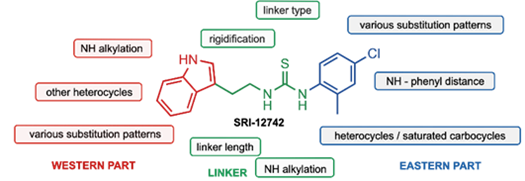
Original molecule structure (Shuka et al. 2018)
Technology Description
- In vitro activity: MIC90 < 0.12 - 0.5 µg/mL for meropenem, minocycline, and/or levofloxacin resistant clinical strains
- In vivo target engagement: novel mode of action without cross-resistance
- In vivo efficacy: Increase survival of zebrafish models by almost 30%
- ADME/T and Pharmacokinetics: small molecule, current topical treatment, potential for systemic administration under development
- PK/PD in vivo: studies in zebrafish larvae demonstrated efficacy of frontrunner, early series derivative showed activity in murine thigh infection model
Commercial Opportunity
The technology is available for co-development and in-licensing partnerships.
Development Status
Front runner under current investigation in murine infection model for target validation.
Patent Situation
A priority patent application was filed in June 2024 (EP24180628).
Further Reading
Original antibiotic – Shukla et al., 2018. International Journal of Antimicrobial Agents 52, 1, 22-27
Licensing Contact

Dr Alejandro Restrepo Arango
Technology ScoutT: +49 531 618120-92
restrepo@ascenion.de
Institute of Origin