
A novel immuno-oncology approach for induction and massive amplification of antigen-specific cytotoxic CD8+ T-cells
Keywords
therapeutic cancer vaccine,HPV-induced tumors,immune-oncology,immunotherapy,antigen-specific CD8+ T cells
Invention Novelty
The technology has a unique therapeutic potential in immunological tumor therapy as it can induce powerful cytotoxic immunity against viral antigens or mutated self-proteins. Current immunization procedures do not enable effective induction of killer T-cells against specific peptide sequences in the patient's body. In addition, alternative immunotherapies often lack specificity or are highly complex and associated with substantial costs per patient.
Value Proposition
The approach reaches a 100-500-fold amplification of cytotoxic killer T-cells compared to currently clinically tested systems, provides a highly effective one-time immunization, and is cost-efficient. The entire procedure is completed within just a few days. It achieves up to 80% antigen-specific CD8+ T-cells in various model systems and complete regression of aggressive tumors could be demonstrated. Due to its universal nature, the system is potentially applicable to all solid cancers. The amplification step itself could be independently integrated into other CD8+ T-cell-based therapies (e.g. TCR-T).
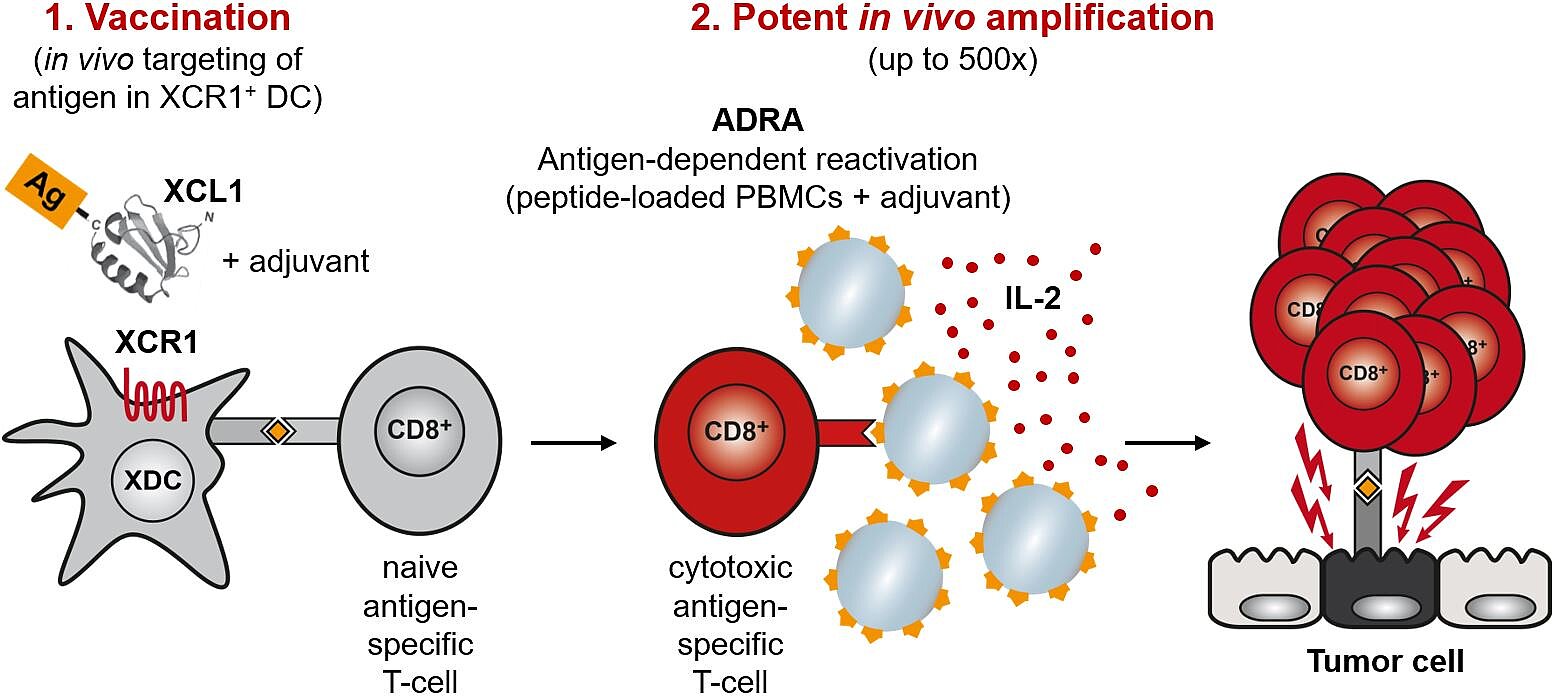
Principle of the technology. Source: R. Kroczek
Technology Description
For primary immunization (Step 1), the antigen is introduced into dendritic cells (DC). Targeting is assured by coupling the antigen to XCL1, the ligand of the cross-presenting DC-specific receptor XCR1. This procedure generates antigen-specific cytotoxic T-cells in vivo. In step 2, CD8+ killer T-cells are reactivated and amplified via autologous PBMCs that were previously loaded ex vivo with the antigen as a peptide and returned to the patient. Subsequent administration of the growth factor IL-2 massively expands the reactivated killer T-cells, which simultaneously increase their cytotoxicity.
Commercial Opportunity
The technology is available for licensing.
Development Status
Extensive validation in mice and Rhesus macaques using several antigens was already performed. The technology is developed towards a clinical proof-of-concept for the first indication “HPV+ head-and-neck cancer” using a standardized vaccine based on HPV16-protein E7. The production of the XCL1 fusion protein for immunization was optimized towards a GMP-ready process, and necessary in vitro assays for preclinical and future clinical testing were established and validated. Further adaption of the modular platform towards cancer vaccines based on foreign shared neoantigens or fully personalized cancer vaccines is possible.
Patent Situation
The technology is protected by a portfolio of granted patents. See patent families WO2009065561, WO2015140175, and WO2015140172 for details.
Further Reading
Dorner et al., Immunity 21 (2009); Kroczek & Henn, Front Immunol 3 (2012); Hartung et al., J Immunol 194 (2015)

Institute of Origin