Advanced tracer compounds for enhanced detection of cellular structures
Keywords
Tracer Compounds, Click Chemistry, Electrophysiology, Fluorophores, Non-Streptavidin Binding, Biotin Analogue
Invention Novelty
The novelty of this invention lies in its innovative use of electroneutral biotin analogues that do not rely on traditional streptavidin binding for cellular labeling purposes. The incorporation of bioorthoganol functionalities amenable to click chemistry, such as azides and alkynes, permits precision labelling through efficient and stable conjugation with reporter molecules, whilst remaining “whole-cell-safe” for patch clamp electrophysiology experiments. This method mitigates the drawbacks of existing labeling techniques, such as poor signal-to-noise and electrical interference, permitting the fine detail, multicolor labelling, of morphologically complex cells without compromising their electrical properties. This fosters physiologically accurate and detailed analyses of cellular structures, including complex dendritic protrusions and axonal processes.
Value Proposition
The technology described utilizes Nobel-prize winning “Click-Chemistry” for labeling and visualizing fine cellular structures with exceptional precision. The highly specific nature of bioorthogonal chemistry ensures consistent and high-quality imaging outcomes, overcoming common drawbacks associated with traditional biotin-streptavidin labelling. With its superior performance, it has the potential to surpass biocytin-streptavidin as the gold standard in cell labeling applications. Enhanced labelling tools are welcomed in the field of Neuroscience, particularly by researchers undertaking combined morphological and electrophysiological studies, where there is currently a limited choice of commercially available products. Compounds’ compatibility with existing fluorophores, as well as labelling techniques and click chemistry protocols, makes them exciting and versatile tools suitable for a wide range of experimental setups, empowering researchers to achieve deeper insights into cellular dynamics and physiology.
Technology Description
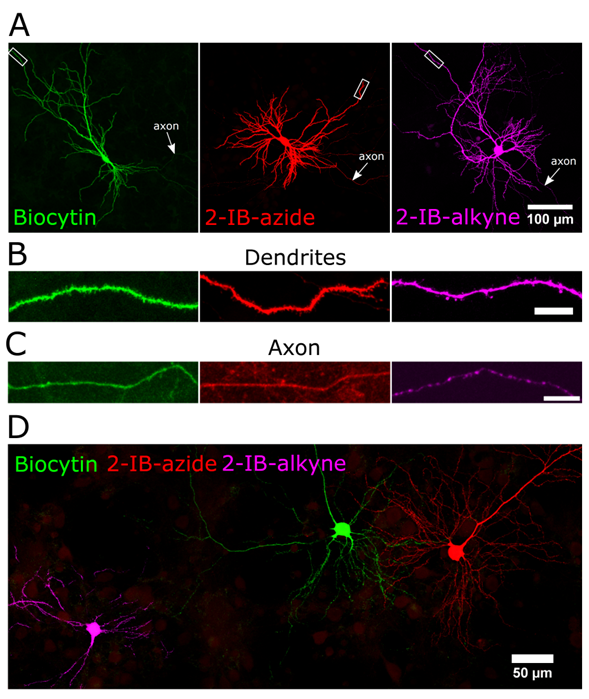
These tracers consist of fixable, water soluble, non-streptavidin binding biotin analogues capable of diffusing within cells similarly to conventional biocytin but which carry one or more click-chemistry compatible functional groups. Azide and alkyne functional groups are capable of rapidly forming stable linkages with fluorescent dyes under copper and copper-free conditions. Each tracer can be engineered to have a unique set of functional groups, which greatly facilitates multicolor / multichannel imaging. The bioorthogonal nature of the functional groups preserves the physiological integrity of the cell, whilst still permitting high resolution imaging. The method described is particularly emphasized for its application in neuroscience research, where it allows for the detailed examination of neuronal processes and synaptic connections following electrical recordings, providing an invaluable resource in the study of neural circuitry and cellular communication.
Commercial Opportunity
We are looking for a licensing or/and cooperation partner.
Development Status
Proof of concept of a combined electrophysiological and multicolor labelling of neighboring neurons with no significant differences to the ‘gold standard’ biocytin could be demonstrated.
Patent Situation
A European patent application was filed in October 2024.
Licensing Contact

Dr Céline Christiansen-Mensch
Technology ManagerT: +49 (0)1590 4836722
christiansen@ascenion.de
Institute of Origin