
Advancing Bioproduction: HDLBP overexpression enhances protein production and secretion
Keywords
Bio Production, Therapeutic Proteins, Biologics, Biosimilars
Invention Novelty
The production of biopharmaceuticals is a central pillar of health care. Means to optimize and enhance recombinant protein production for medical purposes is of great social and economic importance. The present invention provides a novel method for improved secretion of recombinant proteins through targeted codon optimization and simultaneous expression of the RNA-binding protein HDLBP in the mammalian expression system.
Value Proposition
The biotherapeutics market is expanding, leading to an increased demand for proteins from mammalian expression systems. However, the biopharmaceutical industry faces the challenge of efficiently producing these proteins in large quantities. New strategies and methods are needed to increase production, expression, and secretion of recombinant proteins in cellular expression systems. The present invention offers a method to engineer a next-level cell factory that considers bottlenecks in the protein expression process, such as translation, protein folding, secretion, and cell viability, through a holistic approach.
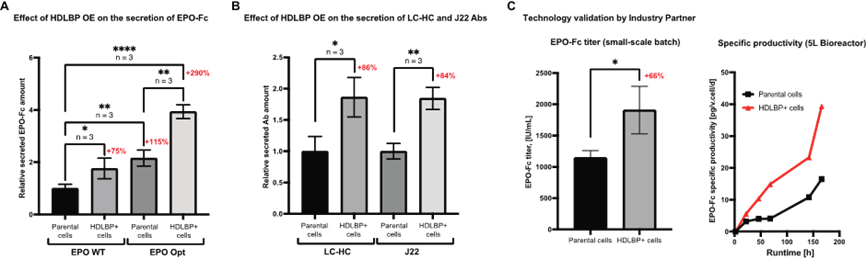
Fig 1 A) Relative expression of EPO-Fc in the cell culture medium from cells without HDLBP overexpression (parental cells) and HDLBP-overexpressing CHO cells (HDLBP+ cells) stably transfected with EPO-Fc (EPO WT) and codon-optimized EPO-Fc construct (EPO Opt) as determined by ELISA assay. B) Relative expression of antibodies, LC-HC and J22 in parental cells and HDLBP+ cells as determined by ELISA assay (modified by Minia and Landthaler). C) Left panel: EPO-FC from parental cells and HDLBP+ cells after 6 days of cultivation in a small-scale batch culture as determined by ELISA assay; Right panel: EPO-Fc specific productivity in parental and HDLBP+ cells as monitored for 166 h in fed-batch 5L bioreactor (modified by Minia and Landthaler).
Technology Description
Based on fundamental biochemical, transcriptomic, and proteomic studies, the researchers identified the important role of the RNA-binding protein HDLBP as an enhancer of translation at the endoplasmic reticulum and subsequent secretion of proteins in eukaryotic cells. As demonstrated in CHO cells, targeted codon-optimization of the respective gene of interest and concomitant expression of HDLBP leads to an increased secretion of human erythropoietin (EPO-Fc) of up to 290% and antibodies of up to 80-85% (Fig.1 A, B). Strikingly, this method does allow high cell density growth and it can be adapted in context of any expression system.
The technology has been validated in industrial settings, showing a remarkable increase in EPO-Fc titer by up to 66% and a 2.3-fold higher specific productivity in 5L bioreactor test runs in HDLBP-overexpressing CHO, cells resulting in EPO-Fc titers of 1 g/L (Fig. 1C).
Commercial Opportunity
This opportunity is available for in-licensing; strategic partnership for further development is highly welcome.
Development Status
Proof of concept was demonstrated in CHO cells expressing EPO-Fc and antibodies. Technology was validated in industrial setting. Efforts to upscale and optimize the process are ongoing.
Patent Situation
WO2023030914A1 (Increase of protein expression and secretion by artificial co-expression of hdlbp/vigilin). National phases will be entered in EP, US, CA, CN, JP, South Korea, and India.
Further Reading
Zinnall, U. et al.: HDLBP binds ER-targeted mRNAs by multivalent interactions to promote protein synthesis of transmembrane and secreted proteins. Nature Communications 13, 2727 (2022).
Licensing Contact

Dr Céline Christiansen-Mensch
Technology ManagerT: +49 (0)1590 4836722
christiansen@ascenion.de
Institute of Origin