
Bioartificial vascular grafts based on a highly compacted acellular fibrin matrix
Invention Novelty
The development of vascular grafts is an ongoing challenge in the field of tissue engineering. Various prerequisites such as biocompatibility, fast availability and sufficient burst strength need to be considered in the development towards a clinical product. The newly developed process for production of acellular bioartificial grafts perfectly addresses these requirements and enables the production of highly stable tubular fibrin-based grafts for vascular replacement: the fibrin prosthesis.
Value Proposition
Fibrin has been proven to be an appropriate matrix for vascularized tissue constructs due to its biocompatibility and its perfect characteristics for the repopulation with different cell types. However, the lack of stability has substantially limited its clinical application until today. Thus, there is still an unmet need to develop highly stable fibrin-based vascular grafts. The novel production process enables the manufacture of highly stable tubular fibrin segments which can be stored as ready-to-use products for immediate clinical application in vascular surgery.
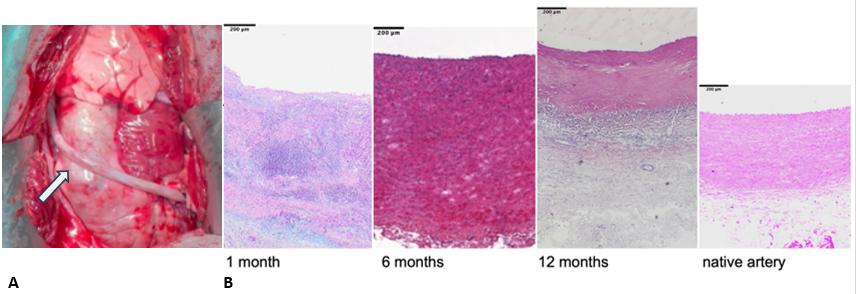
(A) Fibrin prosthesis implanted as aorto-coronary bypass in a sheep for evaluation studies. (B) Histological HE-staining of explanted fibrin grafts, which were implanted in a long-term in vivo-study, visualizes the remodeling process of the fibrin prosthesis in vivo. At the latest after 12 month fibrin prostheses became most similar to the native carotid artery. (T. Aper, 2024).
Technology Description
The standardized and largely automated process comprises the precipitation of fibrin from plasma and subsequent compaction of fibrin by centrifugal forces. It allows for the construction of up to 400 mm long fibrin prostheses with different diameters. Fibrin compaction results in a significant increase of biomechanical stability with a burst strength of ≥900 mm of mercury. It is particularly noteworthy that animal studies demonstrated an astonishing structural similarity between implanted fibrin-based vascular grafts and native arteries at latest after 12 months promising a long-term course of a native artery. Thus, the novel fibrin-based vascular prostheses have excellent mechanical characteristics and striking tissue remodeling properties as well. In view of storage conditions, it is important to mention that engineered vascular grafts can be simply stored at room temperature and are available “off the shelf” during surgery.
Commercial Opportunity
In-licensing is possible.
Development Status
Engineered vascular grafts have been widely tested in vitro and in vivo with very promising results.
Patent Situation
Patent applications in EP and US (based on WO 2025/247909 A1) with priority of 2024 are pending. Further, European patents (EP 3319652 B1, EP 3821919 B1) and US patents (US 11,065,366 B2, US 12,168,083 B2) with priority of 2015 have been granted.
Further Reading
Regenberg MC, Wilhelmi M, Hilfiker A, Haverich A, Aper T. 2023. Development, comparative structural analysis, and first in vivo evaluation of acellular implanted highly compacted fibrin tubes for arterial bypass grafting. J Mech Behav Biomed Mater. 148:106199.
Aper T, Wilhelmi M, Gebhardt C, Hoeffler K, Benecke N, Hilfiker A, Haverich A. 2016. Novel method for the generation of tissue-engineered vascular grafts based on a highly compacted fibrin matrix. Acta Biomater. 29:21-32.

Institute of Origin