
Biomarker set for early and non-invasive diagnosis and differentiation of renal cell carcinomas
Keywords
biomarker,renal cell carcinoma,ccRCC,mass spectrometry-based diagnostics,liquid biopsy
Invention Novelty
Clear cell renal cell carcinoma (ccRCC) is the most common subtype among all renal malignancies and has the lowest survival rate among the most frequent subtypes. Late-stage diagnosis is a major factor, as ccRCC can be asymptomatic for a long time. Currently, diagnosis is mainly based on histological assessment of the tumor after the identification of a foreign kidney mass, but there are no validated liquid biopsy biomarkers for early screening and diagnosis. This technology addresses this unmet clinical need by providing a novel biomarker set and suitable methods for detection of RCCs from urinary samples.
Value Proposition
The platform is based on parallel reaction monitoring mass spectrometry (PRM-MS) measurements of the biomarker proteins and allows for non-invasive and early-stage detection of different RCC subtypes. Compared to bulk proteomics and other ion monitoring techniques, using PRM-MS can drastically reduce the run time per sample and increase specificity. This approach can facilitate ccRCC diagnosis and has the potential to enable cost-effective and sensitive future population-wide screening programs when incorporated into routine practice in clinical proteomics laboratories.
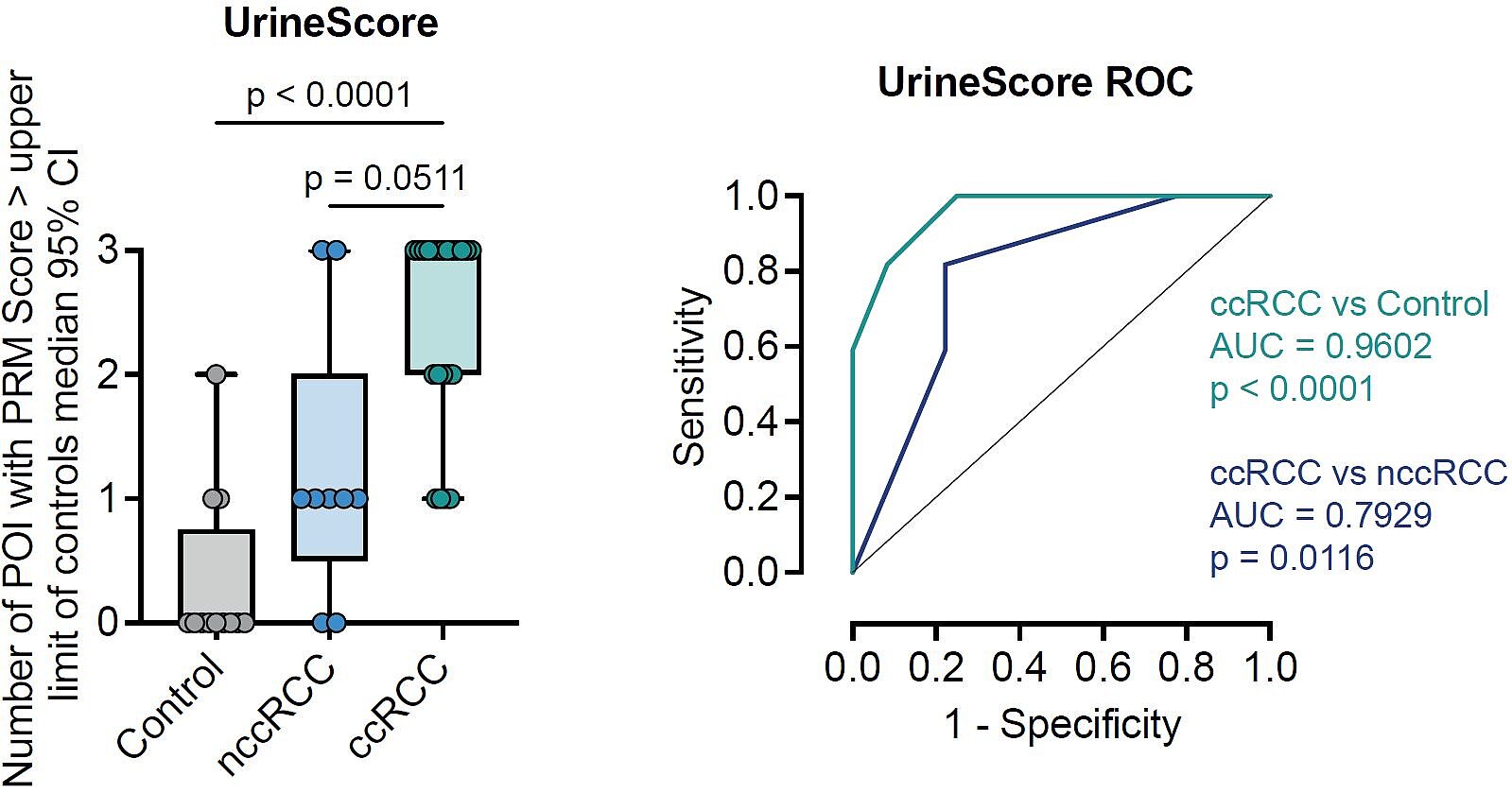
Performance of the UrineScore in diagnosing and differentiating
renal cell carinomas. Source: Jonsson et al. 2026
Technology Description
Serum amyloid A1, Haptoglobin, and Lipocalin 15 were found to be significantly upregulated in the urine of ccRCC patients compared to healthy individuals, and urinary amounts of SAA1 and HP allowed ccRCC to be distinguished from non-ccRCC malignancies. Three housekeeping proteins with unchanged urinary levels were identified and are used as a reference for standardization. For PRM-MS detection, a pre-selected peptide signature from proteins of interest (POI) and housekeeping proteins was established. A PRM score was defined for each POI and individual PRM scores were combined into a cumulative UrineScore. This score accurately distinguishes ccRCC and control samples and performs well in discriminating non-ccRCC from ccRCC cases.
Commercial Opportunity
Application as IVD test for clinical diagnostics. The peptide signature can be developed into a MS calibration kit. The technology is available for licensing. Partnering for further co-development is also highly welcome.
Development Status
Biomarkers were established using a clinical discovery cohort of 43 individuals in Vienna. The UrineScore was further validated in a Spanish cohort (n=26).
Patent Situation
A European patent application was filed in July 2024 (EP24190080.2). PCT application filed.
Further Reading
Jonsson et al. (2024), bioRxiv preprint: https://www.biorxiv.org/content/10.1101/2024.08.12.607453v2
Jonsson et al. (2026), EMBO Molecular Medicine: https://link.springer.com/article/10.1038/s44321-026-00498-2

Institute of Origin