Broad-spectrum antiviral compounds against known and emerging viruses
Keywords
broad-spectrum antivirals,viral attachment inhibitor,viral entry inhibitor,viral infections,first-in-class,pandemic
Invention Novelty
Researchers of the Charité University Hospital Berlin have developed a novel class of small molecule compounds that block virus attachment and entry at an early stage. These antivirals exhibit their function by targeting and blocking heparan sulfate proteoglycans (HSPGs), a molecule on host cell membranes that is utilized by numerous viruses for host cell adhesion.
Value Proposition
The recent outbreaks of viruses such as SARS-CoV-2 and monkeypox have underscored the global threat posed by emerging viruses. Most existing antivirals are direct-acting and target specific elements of a single virus, resulting in a limited spectrum of possible virus coverage. However, predicting new virus variants and their specific druggable features remains extremely challenging. Additionally, multiple viruses can become relevant simultaneously in conditions such as opportunistic infections in transplant recipients, HIV-positive individuals, or immunosuppressed cancer patients. This highlights the urgent need for broad-spectrum antivirals that target mechanisms essential to the infection of many viruses. Such compounds could also serve as a reserve option for currently available drugs and as a countermeasure against future viral outbreaks or highly pathogenic viruses.
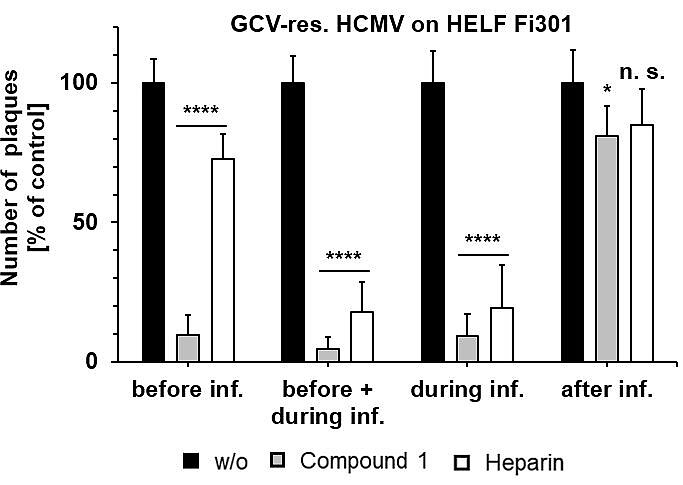
Plaque counts after Compound 1 treatment at different infection stages indicate early antiviral interference. Source: patent application
Technology Description
Due to its molecular structure design, “Compound 1” blocks key functional groups of HSPGs via electrostatic interactions. Significant in vitro efficacy has already been shown against a multitude of viruses from different classes, including HSV-1, HCMV, HIV-1, Pseudorabies virus, ZIKA virus, and O’nyong-nyong virus. Notably, the compound exhibited stronger antiviral effects against HIV-1 than Didanosine and was also effective against a Ganciclovir-resistant HCMV strain, protecting the cells for at least 5 days post-infection. It also outperformed acyclovir in reducing viral brain titers in an HSV-1 encephalitis mouse model. The compound is highly water-soluble, making it suitable for various pharmaceutical formulations, including topical, transmucosal, inhalation or systemic administration. It is also highly stable, easy and inexpensive to synthesize. In addition, the compound exhibits minimal in vitro toxicity across various organ cell lines and a highly favorable in vivo safety profile across the cardiovascular, gastrointestinal and central nervous systems at doses of 50-250 mg/kg.
Commercial Opportunity
We are seeking a commercial partner to co-develop the technology and/or explore licensing. Given its broad virus coverage, the compound shows potential for human and animal healthcare as a first-in-class drug.
Development Status
Further in vitro studies with additional virus types, and in vivo safety and efficacy testing in animal infection models are ongoing. The cell permeability properties of the compound will be examined using organ-on-chip models.
Patent Situation
Published international patent application WO2026041790A1 (priority August 2024).
Further Reading
A manuscript is currently in preparation.

Institute of Origin