CD3-CAR NK-92 cell-mediated TCR+ depletion
Keywords
CAR, immunotherapy, T cell product, allogeneic, off-the-shelf , NK cells
Invention Novelty
The technology comprises a method to optimize the purity and cell yields during the manufacturing of allogeneic “off-the-shelf” CAR T cells with reduced risk for adverse immune reactions (Fig. 1A). This innovative approach addresses some of the limitations associated with autologous CAR T therapies, such as manufacturing complexity, cost, and scalability.
Value Proposition
Autologous CAR T cell manufacturing is logistically challenging and expensive, limiting patient access to therapy. Off-the-shelf allogeneic CAR T cells present a solution to these issues, as they are anticipated to lower costs through large-batch manufacturing. However, these therapies carry a significant risk of inducing Graft-versus-Host-Disease (GvHD), driven by the T cell receptor (TCR/CD3) complex. To mitigate this risk, a novel cell-mediated purification method for TCR-modified (CAR) T cell products has been developed. This technology improves their safety profile by eliminating TCR+ T cells from the cell cultures. Unlike conventional purification methods, this technology avoids cell loss and supports effective expansion of CAR-T cells without affecting their effector function.
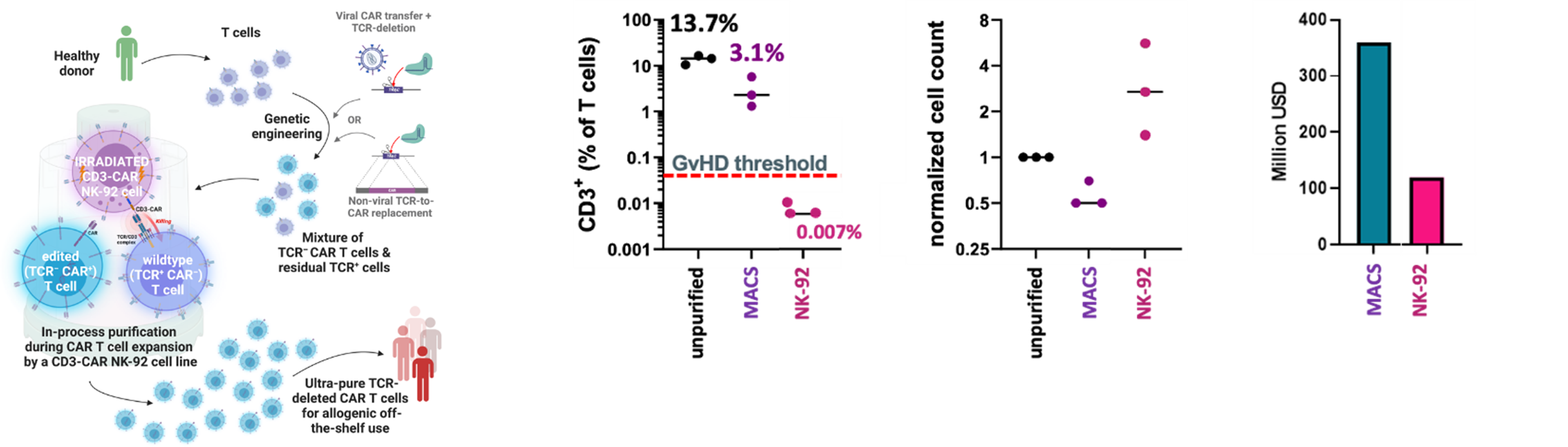
Fig. 1 A: Manufacturing of allogeneic “off-the-shelf” CAR T cells by means of TCR/CD3-specific CAR NK-92 cell lines for the removal of residual TCR+ AT-cells from TCR-deleted CAR T-cell product. B: CAR NK-92 cells allowed to produce TCR– CAR T cells with <0.01% TCR+ T cells. C: Purification with CAR NK-92 avoids MACS-associated cell loss and improves yield though feeder effect. D: Projected yearly costs for manufacturing of 20,000 allogeneic cell products. (Fig. modified after Kath et al., 2023)
Technology Description
The novel technology employs a genetically modified NK-92 feeder cell line equipped with a CD3-specific CAR to purify allogeneic TCR/CD3-negative T cell products. This method replaces the complex bead-mediated depletion procedure and prevents the loss of valuable allogeneic T cells. The NK-92 cells are gamma-irradiated to induce apoptosis, ensuring their absence in the final product. Two consecutive co-culture cycles with these cells enable highly efficient eradication of residual TCR/CD3+ T cells in TCR-knock-out or TCR-knock-in CAR T cells. The technology reduces impurities below the GvHD threshold, improves product yield by a factor of 4, cuts manufacturing costs by 65%, and de-risks the development of allo-strategies by preventing GvHD. (Fig. 1C, D).
Commercial Opportunity
In-licensing or collaboration for further development.
Development Status
In vitro proof of concept in semi-closed culture systems such as a G-Rex bioreactor device.
Patent Situation
A European priority application (EP22200627.2) was filed in 2022, followed by a PCT application (PCT/EP2023/078031) in October 2023.
Further Reading
Kath J, et al.: CAR NK-92 cell-mediated depletion of residual TCR+ cells for ultrapure allogeneic TCR-deleted CAR T-cell products. Blood Adv. 2023 Aug 8;7(15):4124-4134, https://doi.org/10.1182/bloodadvances.2022009397.
Licensing Contact

Dr Céline Christiansen-Mensch
Technology ManagerT: +49 (0)1590 4836722
christiansen@ascenion.de
Institute of Origin