Component-resolved basophil activation test for classifying allergy status and severity
Keywords
basophil activation test (BAT), component-resolved diagnostics, allergy severity, risk stratification, oral food challenge, peanut, algorithm
Invention Novelty
Skin prick tests (SPT) and serum IgE assays detect sensitization but cannot reliably predict clinical reactivity or its severity. Hence, unclear cases, particularly in food allergy, often require oral food challenges (OFCs), which are time-consuming, resource-intensive and carry the risk of potentially severe reactions. The basophil activation test (BAT) can help distinguish clinically relevant allergy from asymptomatic sensitization. Previous approaches, however, mostly rely on an allergen extract or a few individual allergens and on the proportion of CD63-positive basophils, and their ability to grade allergy severity has been limited. The invention combines a component-resolved BAT, using an extract together with major and lipid-associated allergens of the same source, with a rule-based algorithm that integrates basophil activation and changes in CD63 and CD203c expression to classify both allergy status and severity from a single blood sample.
Value Proposition
The method provides an in vitro classification of allergy status and expected reaction severity before an OFC is considered. It can thus support the selection of patients who require a challenge and may help to avoid unnecessary OFCs; in the longer term, it could also inform dietary advice and therapy decisions. Building on the robust and automatable BAT platform of TO 14-00142, the method requires only a small panel of allergen stimuli, and can be implemented in central and specialized laboratories.
Technology Description
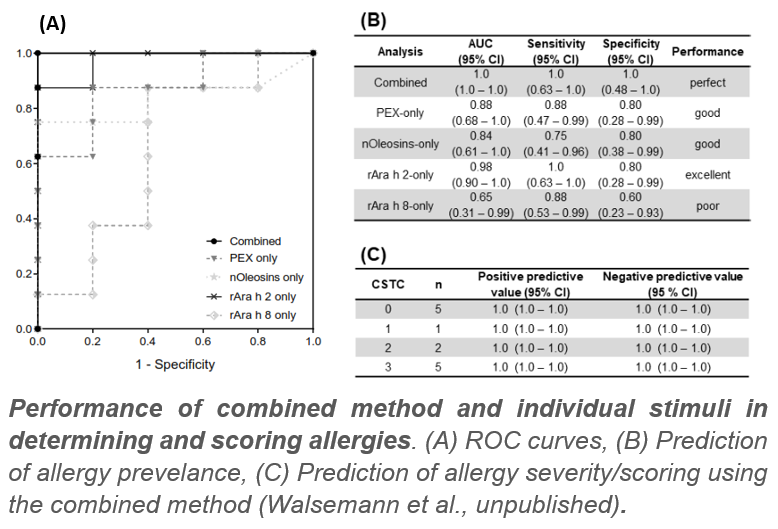
Conventional BATs usually rely on a single stimulus, typically a whole allergen extract, or on one or two individual allergen components. Extract-based tests, however, also show substantial basophil activation in some sensitized but tolerant individuals and provide only limited information on the severity of the allergy and the patient's tolerance threshold. The invention stimulates separate blood aliquots, each with exactly one stimulus from a defined set derived from the same allergen source: an extract, a major allergen, optionally a minor allergen, and a lipid-associated allergen (e.g., oleosins in peanut). Positive controls (anti-IgE, fMLP) identify non-responders, and an unstimulated control serves as reference. For each stimulus, the proportion of activated basophils and the fold change in CD63 and CD203c expression are determined. A rule-based algorithm combines these parameters, including the number of stimuli to which a patient reacts, to assign the patient to a combined symptom and tolerance class (CSTC 0: no allergy, high tolerance; CSTC 1: mild allergy, substantial tolerance; CSTC 2: moderate allergy, moderate tolerance; CSTC 3: severe allergy, low or no tolerance). The CSTC classes were defined on the basis of the objective symptoms and the eliciting dose observed during OFCs, so that the BAT result can serve as a surrogate for the expected outcome of a challenge.
Commercial Opportunity
The technology is available for licensing and co-development.
Development Status
Proof of concept was obtained in 15 children with suspected peanut allergy who underwent a single-blind OFC. Peanut extract activated basophils in three of five OFC-negative children, whereas Ara h 2, oleosins and Ara h 8 did not – illustrating the added value of component-resolved stimulation. Thirteen children (87 %) were BAT responders, and the algorithm assigned all of them to the class determined by OFC (CSTC 0: n = 5; CSTC 1–3: n = 8). As the classification thresholds were defined in this cohort, a prospective validation in an independent cohort and extension to further allergen sources are underway.
Patent Situation
The international application WO2025/003040A1 has entered the national/regional phases in EP and the US.
Further Reading
Behrends, et al. (2021) Allergy 76: 3776-3788.
Licensing Contact

Dr Torsten Stachelhaus
Technology ManagerT: +49 40 1888 43 48
stachelhaus@ascenion.de
Institute of Origin