Consolidated Bioprocessing of Complex Carbohydrates to D-Erythro-Isocitric Acid Using a Fungus
Keywords
consolidated bioprocessing, isocitric acid, cellulase, Penicillium, Talaromyces, sustainable chemistry, renewable
Invention Novelty
This invention provides a method for the one-step bioproduction of enantiomer-pure D-erythro-isocitric acid as a platform fine chemical from complex carbohydrate substrates such as cellulose using a natural fungus from the genus Talaromyces. This method enables direct conversion without the need for genetically modified organisms (GMOs), presenting a significant advancement in the field of bioprocessing and sustainable chemical production resulting in the most favorable substrate cost-to-product ratio.
Value Proposition
The traditional processes for converting lignocellulosic materials into valuable chemicals involve multiple steps such as a separate production of cellulase enzymes, conversion of the pretreated cellulose substrate into sugar mono- and oligomers, and finally fermentation into the product of interest. The three separate processes require three separate bioreactors and peripheral equipment, which is costly and results in a decreased space-time yield compared to a consolidated bioprocess (CBP), in which pretreated cellulose substrate is directly converted into the target product within a single bioreactor. The only CBP strategies that reached relevant product quantities are co-cultures as well as native cellulolytic approaches with GMOs, the use of which can be costly and complex. Thus, in the context of the fossil resources transition to a circular economy, new methods for a sustainable production of chemical building blocks as well as carriers of energy are urgently needed.
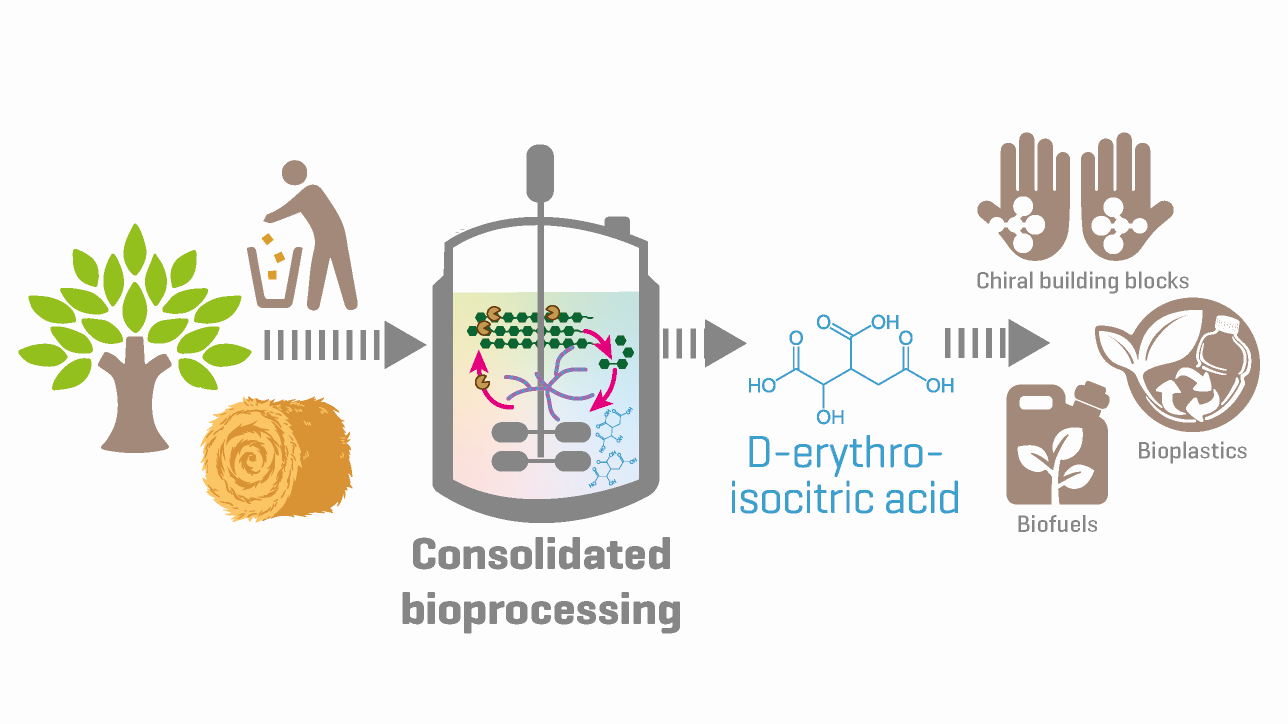
Production of D-erythro-isocitric acid from cellulose via consolidated bioprocessing. © Schlembach et al.
Technology Description
The offered technology simplifies the process by using a natural, non-GMO fungal strain capable of directly converting cellulose into D-erythro-isocitric acid. This offers a cost-effective, sustainable, and scalable solution for producing high-value chemicals from renewable resources. The invention involves cultivating a suitable fungus in a medium containing complex carbohydrate under specific conditions, like cultivation at temperatures ranging from 25° to 40°C, and a pH of the culture maintained ideally around 5.5. Additionally, nitrogen limitation in the medium is crucial to induce the production of isocitric acid. This method achieves the direct production of D-erythro-isocitric acid from cheap agricultural residues like straw with high purity and yield, providing a viable alternative to traditional multi-step processes.
Commercial Opportunity
The production of D-erythro-isocitric acid directly from cellulose offers a sustainable and economical approach to chemical production. Isocitric acid’s properties can be highly beneficial for i.a. pharmaceutical and cosmetic applications. The technology and a proprietary Talaromyces-production strain are offered for licensing.
Development Status
The method has undergone extensive laboratory validation, demonstrating its efficacy in producing high yields of D-erythro-isocitric acid from cellulose. Current research focuses on optimizing the process parameters and industrial up-scaling.
Patent Situation
An international patent application has been filed on March 7, 2024 (PCT/EP2024/056067).
Further Reading
Ivan Schlembach, et al., (2024) ACS Sustainable Chemistry & Engineering 12 (9), 3408-3418.

Institute of Origin