EvolChip - A Convection-Driven Gradient Reactor for the Rapid Generation of Drug Concentration Gradients
Value Proposition
The EvolChip addresses a pressing, high-value need, as the global rise of antimicrobial resistance has made bacterial infections a growing threat to public health. Against this backdrop, laboratories increasingly seek faster and reliable antimicrobial susceptibility testing (AST) results that can also support antimicrobial stewardship programs and more targeted antibiotic use.
The EvolChip’s versatility is a key commercial strength: beyond AST applications, it should enable studies of the efficacy of antibiotic, antifungal, chemotherapeutic or other drug combinations, while assessing the sensitivity of pathogenic microorganisms or cells and investigating resistance development. Its distinctive advantages - high combination coverage, rapid gradient formation, dynamic adaptability for investigating changing drug-exposure profiles, automation potential and simulation-guided gradient design - create strong co-development and partnership opportunities across diagnostics, anti-infective R&D and the pharmaceutical industry, as susceptibility profiling is increasingly being integrated into drug development, clinical trials and global health initiatives.
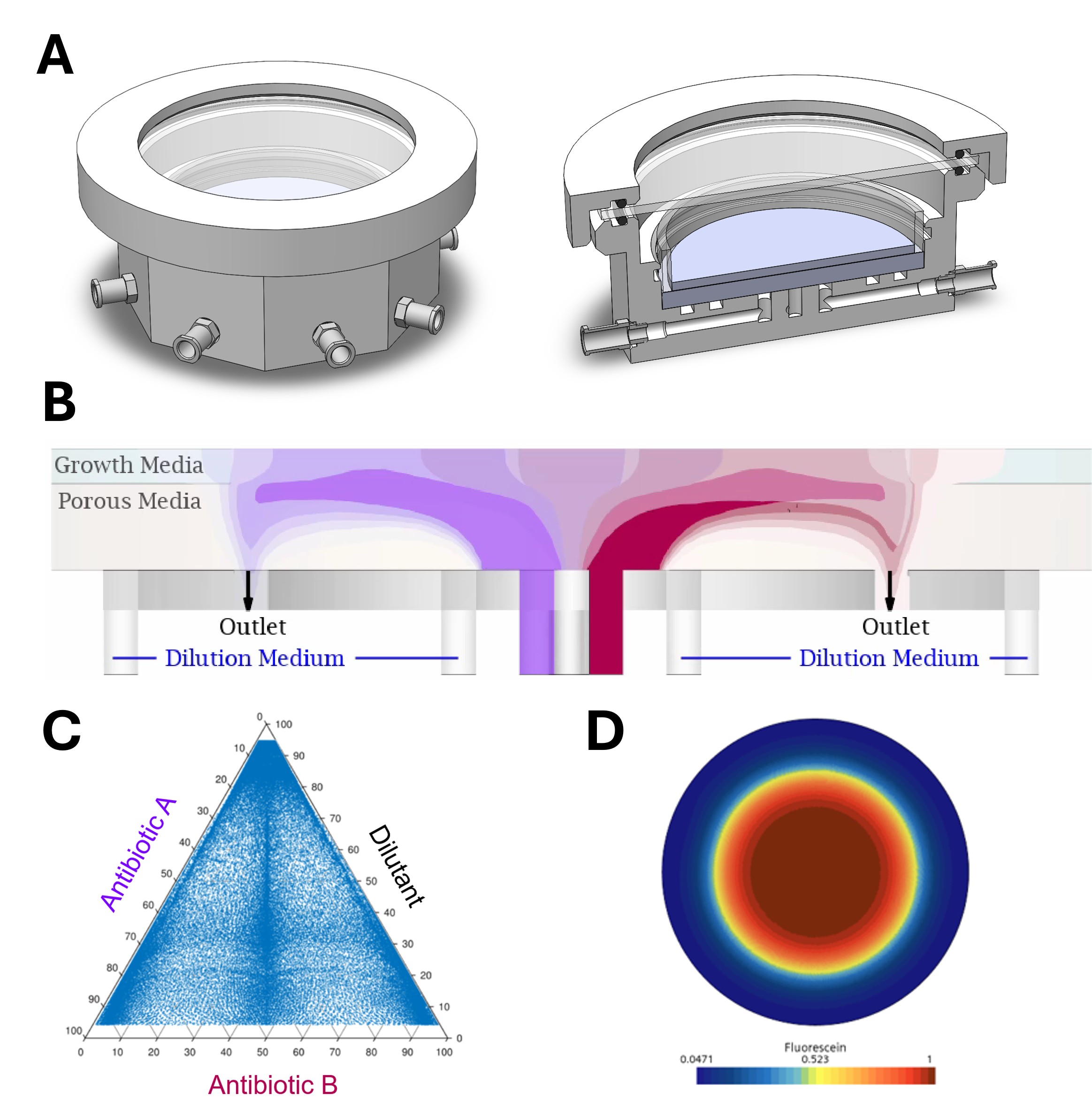
EvolChip Gradient Reactor: A) EvolChip reactor design; B) convection- and diffusion-based gradient generation; C) concentration-combination space; D) simulated fluorescein gradient
Technology Description
The EvolChip reactor is designed to generate defined drug concentration gradients across a thin growth layer on which microorganisms can be cultivated. Drug solutions and diluent are introduced through dedicated inlet channels. Active convective mixing first generates the concentration profile within a porous layer directly beneath the growth medium. Continuous flow maintains this profile, while drug molecules diffuse over a short distance into the thin growth layer above. Adjusting the inflows is intended to enable modification of the gradient over time and may support the investigation of changing drug-exposure conditions. The current prototype uses a porous glass filter, although alternative porous materials, such as stainless steel or 3D printed structures, may also be suitable.
Commercial Opportunity
The technology is available for co-development, pilot and validation studies, joint grant-funded projects and strategic partnerships.
Development Status
Functional prototype developed; proof-of-concept for overlapping gradient formation demonstrated using fluorescence-based experiments. Further technical and biological validation is ongoing.
Patent Situation
Published international patent application: WO 2026/176111 A1.

Institute of Origin