Detuning-Ratio Analysis (DRA): First real-time method to detect isomeric interferences in LC-MS/MS diagnostics
Invention Novelty
The Detuning-Ratio Analysis (DRA) is a novel LC-MS/MS-based method that enables real-time detection of isobaric and isomeric interferences in small-molecule analytes (<1,500 Da). DRA works by comparing ion yields under optimal and detuned conditions to generate compound-specific fingerprints that reveal co-eluting interferences before they can cause quantification errors. Unlike traditional ion ratio approaches, which are limited to analytes with multiple transitions, or 2D-LC-MS, which is both costly and time-consuming, DRA works seamlessly for single-transition compounds, which represent about 60 % of all small molecules in LC-MS/MS applications. The method requires no additional hardware, and the core algorithm is designed for integration as a software plugin for existing MS platforms. DRA has been validated for a range of applications, including steroids (Cortisone and Prednisolone) and pharmaceuticals (O-Desmethylvenlafaxine/cis-Tramadol HCl), and offers significant advantages in clinical diagnostics, doping control, forensic toxicology, and environmental analysis – fields where conventional interference detection methods are often inadequate. Peer-reviewed validation has demonstrated DRA’s robustness and quantitative capabilities, marking a paradigm shift in LC-MS/MS analytics.
Value Proposition
Routine LC-MS/MS analyses in clinical, anti-doping, and pharmaceutical laboratories are increasingly challenged by undetected isobaric and isomeric interferences, which can compromise 5–15 % of tests and result in costly false results, patient harm, or errors in athlete sanctions, including both unjust punishment and missed detection of rule violations. Traditional solutions, such as ion ratio monitoring, are ineffective for isomers and single-transition analytes, while advanced methods like 2D-LC-MS or isotope ratio mass spectrometry are prohibitively expensive and time-consuming, often exceeding $500 per sample and 12 hours per run. This problem is further exacerbated in emerging chromatography-free MS platforms, where the absence of chromatographic separation can increase interference rates by 3- to 5-fold. DRA addresses these challenges by offering a rapid (less than 5 minutes extra per sample), cost-effective ($5–15 per analysis), and highly sensitive (>90 % detection rate) solution. DRA integrates seamlessly with existing MS platforms, aligns with regulatory guidelines, and reduces unnecessary confirmatory tests by up to 80 %, positioning laboratories and manufacturers as “interference-aware” and enhancing both compliance and competitive differentiation.
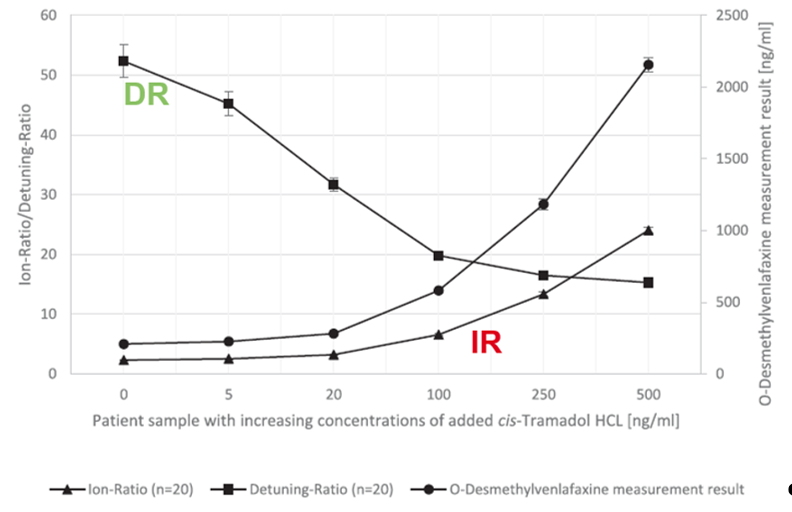
Comparison of IR and DR curves with the O-Desmethylvenlafaxine measurement curve from a patient sample (208.7 ng/mL O-Desmethylvenlafaxine) spiked with increasing concentrations of cis-Tramadol HCl (Rexhaj et al., 2025).
Technology Description
DRA was initially developed for LC-MS/MS-based analytics to facilitate real-time detection of isobaric and isomeric interferences by calculating a compound-specific detuning ratio (DR) for each chromatographic peak. The approach involves recording two MS/MS chromatograms under optimal (maximal ion yield) and detuned (suboptimal, such as collision energy) conditions. The DR is defined as the ratio of peak areas between these two settings and is compared to a predefined reference value for the pure analyte, with deviations greater than 10 % indicating a potential interference. DRA has been validated for steroids, detecting Cortisone and Prednisolone interferences at concentrations as low as 5 ng/mL, with DR shifts up to 22.56 % at higher interference levels (see figure). It has also shown high sensitivity for drug metabolites such as O-Desmethylvenlafaxine and cis-Tramadol, supporting applications in therapeutic drug monitoring and clinical toxicology.
Commercial Opportunity
DRA technology is available for licensing and in-house validation.
Development Status
DRA has reached TRL 4, with successful validation in a laboratory environment, e.g., for the analysis of Cortisone/Prednisolone. Currently, data analysis is performed using custom scripts with instrument-specific calibration. However, further validation for additional applications, such as doping analysis, as well as integration into commercial mass spectrometry (MS) software, are envisioned.
Patent Situation
The technology is protected by a priority-establishing EP patent application filed in Nov. 2024 and a PCT application submitted in Nov. 2025.
Further Reading
Rexhaj et al. (2025) J. Mass Spectrom. Adv. Clin. Lab. 37: 56-64
Licensing Contact

Dr Torsten Stachelhaus
Technology ManagerT: +49 40 1888 43 48
stachelhaus@ascenion.de