
Diagnostic assay for determination of personal microbial metabolite production profile for nutritional adjustment
Keywords
Microbiome, bacterial metabolites, personalized nutrition, qRT-PCR, chronic diseases, inflammatory diseases
Invention Novelty
Scientists of the Experimental and Clinical Research Center and Max Delbrück Center developed an innovative diagnostic assay, which allows the targeted profiling of gut microbiome genes from stool samples. The assay offers the potential to quantify the microbial profile and related metabolite production capacity of critical genes to tailor individual nutrition, enhancing health outcomes.
Value Proposition
Microbiome imbalances, or dysbiosis, affect the production of bacterial metabolites, influencing human health. These metabolites, absorbed into the bloodstream, significantly impact immunity and inflammation, contributing to chronic diseases. Most state of the art methods for gut microbiome profiling are based on cost and time intensive whole genome sequencing approaches. The here proposed assay offers a rapid, reliable, and cost-effective solution for understanding and monitoring the gut microbiome's impact in health and disease, e.g. chronic kidney disease. By providing detailed gene expression profiles, it aids in personalizing dietary recommendations, potentially reducing disease progression and improving patient outcomes. Its robust and reproducible protocol makes it suitable for clinical and research applications, filling a significant gap in the diagnostic landscape.
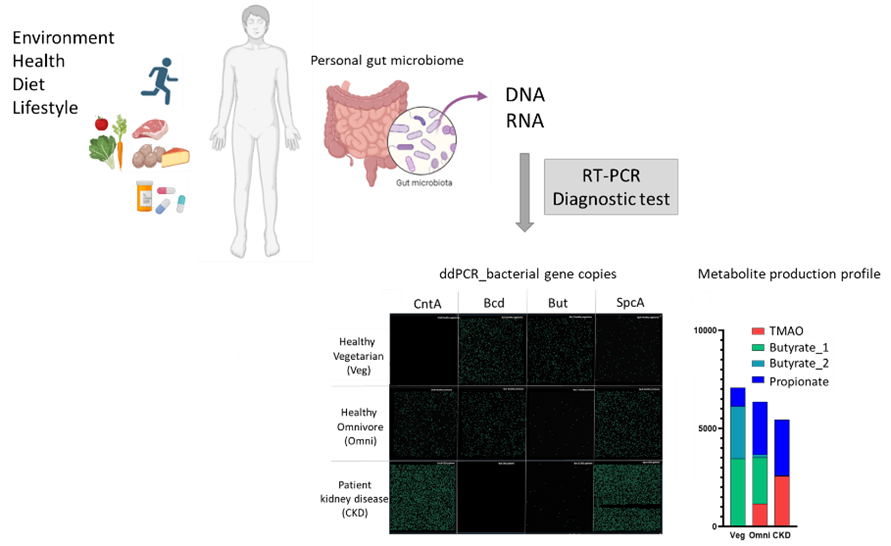
The RT-PCR microbiome profiling kit provides an individual picture of metabolite production potential in the human gut microbiome that reflects personal health status as well as diet and lifestyle factors.
Technology Description
The assay offers a rapid, reliable method to quantify the abundance and expression of specific gut microbiome genes from human stool samples. Degenerated primers with a unique selectivity and sensibility were developed and validated in-house. By measuring mRNA and DNA levels via RT-qPCR, the assay can infer the microbiome's metabolite production capacity. Key genes associated with metabolite production, such as short-chain fatty acids (SCFA), trimethylamine-N-oxide (TMAO), and indoxyl sulfate (IS), are targeted to assess their roles in chronic diseases. The assay was already validated for small CKD patient cohorts and nutritional challenges.
Commercial Opportunity
This opportunity is available for in-licensing. Co-development is highly welcomed.
Development Status
Validated in healthy and diseased patient cohorts, further validation on-going.
Patent Situation
PCT application WO2024008787A1 filed with priority of July 2022.
Further Reading
Holle J., et al. Inflammation in Children with CKD Linked to Gut Dysbiosis and Metabolite Imbalance. J Am Soc Nephrol. 2022.
Holle J., et al. Gut dysbiosis contributes to TMAO accumulation in CKD. Nephrol Dial Transplant. 2024.
Licensing Contact

Dr Céline Christiansen-Mensch
Technology ManagerT: +49 (0)1590 4836722
christiansen@ascenion.de
Institute of Origin