Efficient Generation of Murine Brain Organoids from Adult Neural Stem Cells
Keywords
Brain organoids, murine neural stem cells, adult stem cells, 3D cell culture, neurodegenerative diseases, organoid models
Invention Novelty
This invention introduces a novel method for producing murine brain organoids from adult neural stem cells, offering a faster and more reproducible alternative to current approaches that rely on iPSCs or embryonic progenitor cells. Unlike these methods that require complex and time-consuming procedures, this novel approach leverages neural stem cells from adult mice to generate brain organoids that closely mimic in vivo brain structures, allowing for physiologically relevant research. Therefore, this method significantly reduces the need for animal testing.
Value Proposition
The method enables the rapid generation of brain organoids in just 3-4 weeks, which is considerably faster than current technologies. It offers researchers a scalable, efficient, and reproducible system to study brain development and pathological changes of the brain as well as the possible impact factors using a murine cerebral organoid cell culture model. The ability to generate customized organoids from a wide variety of established mouse models — including genetically modified strains — makes this protocol particularly versatile. By reducing the number of animals required and allowing genetic modifications prior to organoid formation, it also meets the growing demand for ethical research tools in indications like neurodegeneration, neuro-inflammation and infection disease.
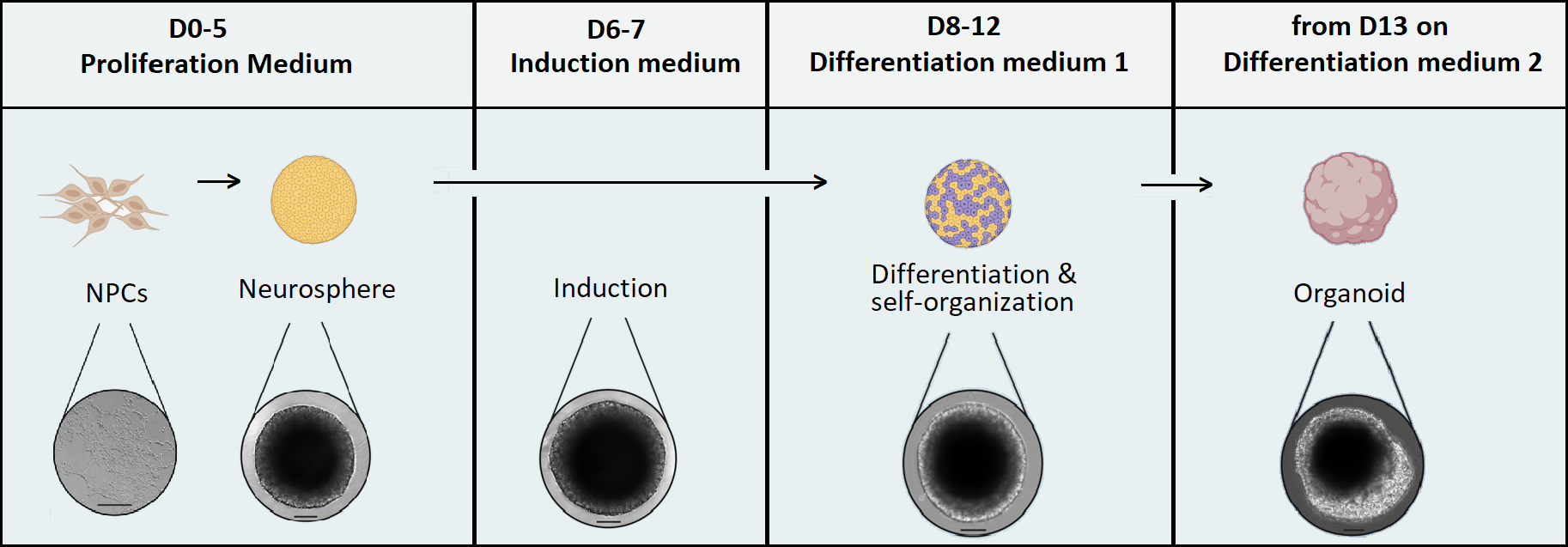
Adult NPCs from 12-25 week old mice were cultured to confluence, formed neurospheres, and after withdrawal of growth factos, self-organized into organoids without ectodermal induction.
© Helmholtz-Zentrum für Infektionsforschung
Technology Description
This method involves the isolation of neural stem cells adult mice. These cells are cultured to form neurospheres, which then differentiate and self-organize into mature 3D brain organoids containing neurons, astrocytes, and oligodendrocytes. These organoids provide a more comprehensive model of the brain's cellular complexity than standard 2D cultures.
The murine cerebral organoid cell culture model can be used in high-throughput assays to enable rapid and scalable applications. This paves the way for application in toxicity screening and drug discovery for brain-related diseases.
Commercial Opportunity
This method has strong commercial potential in drug discovery and neurological research, e.g. for cell culture companies. The technology can be licensed for broad applications like organoid kits or for special applications
Development Status
The method has been successfully demonstrated with the production of high-quality brain organoids. Applications in drug testing and disease modeling are in progress.
Patent Situation
A PCT application was filed in Oktober 2025 (PCT/EP2025/079577).

Institute of Origin