
Fibre Membrane Oxygenator with Minimised Priming Volume
Keywords
oxygenator, ECMO, CPB, microspheres, wound fibre configuration, priming volume reduction, artificial lung, artificial womb
Invention Novelty
Researchers at Charité – Universitätsmedizin Berlin have developed a novel oxygenator architecture for cardiopulmonary bypass (CPB) and extracorporeal membrane oxygenation (ECMO). The novel design incorporates volume-displacing 50–200 µm microspheres into the blood compartment of a hollow-fibre membrane oxygenator, with the aim of reducing the blood-filled volume. This decreases blood film thickness and diffusion distance by ~70% and shortens the time to oxygen saturation by a factor of three compared to conventional oxygenators, leading to a significantly lower priming volume and a more efficient gas transfer. The resulting architecture enables a more compact oxygenator design and may facilitate the development of portable artificial lung systems.
Value Proposition
ECMO is widely used to support patients with severe cardiac and pulmonary failure when adequate blood oxygenation cannot be achieved by the native heart and lungs alone. Despite its clinical benefits, ECMO remains associated with thrombotic complications that can contribute to serious adverse events, including neurological injury and acute kidney injury. Conventional hollow-fibre oxygenators contain a substantial blood-filled volume within the gas-exchange region, which results in relatively thick blood layers surrounding the fibres and correspondingly long diffusion distances for oxygen transfer. The invention addresses this limitation by reducing blood-film thickness, shortening diffusion distances and promoting transverse blood, which may help to minimise stagnant flow regions and blood residence times, potentially contributing to improved hemocompatibility.
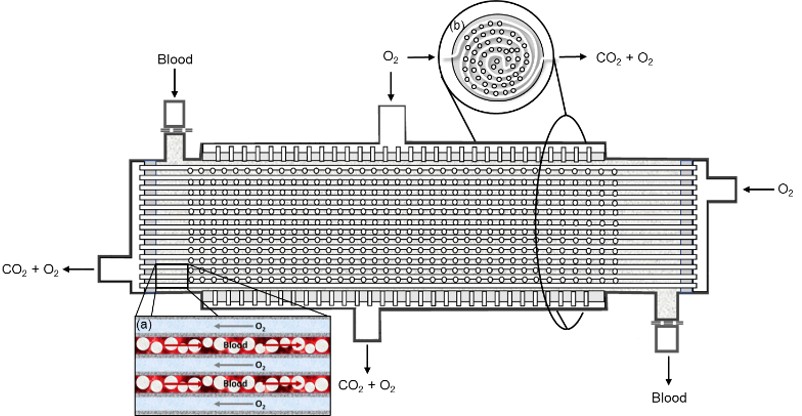
The novel oxygenator offers priming blood volume minimisation through the introduction of (a) microspheres in the blood compartment and (b) second bundle of fibres in the gas compartment (source: PCT/EP2022/080548, modified).
Technology Description
The invention provides a novel oxygenator architecture that improves gas-transfer efficiency by reducing blood-film thickness and diffusion distance within the gas-exchange region through the incorporation of volume-displacing microspheres in the blood compartment. These structures reduce the blood-filled volume and associated priming volume while promoting transverse blood flow and improved mixing. By shortening diffusion distances and increasing gas-transfer efficiency per unit volume, the technology addresses key challenges in the development of blood-contacting extracorporeal devices and enables substantially more compact oxygenator designs.
Commercial Opportunity
We are looking for a licensing or/and cooperation partner.
Development Status
A prototype incorporating microspheres for priming volume reduction has been developed. Proof-of-concept oxygenation experiments and flow simulations have demonstrated the feasibility of the underlying concept. Current development focuses on full-scale prototype testing using 5L blood volumes and on adapting the technology for future applications in artificial womb systems.
Patent Situation
Patent applications based on PCT/EP2022/080548 filed in 2022 are pending in Europe and USA.

Institute of Origin