Functionalized Nanoparticles for Viral Clearance
Keywords
nanoparticles, viral clearance, phagocytosis, virus-binding peptides, high-affinity binding, antiviral therapy
Invention Novelty
Nanoparticles equipped with high-affinity virus-binding peptides for virus encapsulation to induce virus phagocytosis before cell infection.
Value Proposition
• New MoA: by forming aggregates with the viruses, these nanoparticles facilitate the clearance of viral particles through phagocytosis
• Target engagement: initially developed for SARS-CoV-2, the nanoparticles show ~5 pM Kd towards the spike protein and low-nM range with Omicron strains
• In vitro efficacy: Single dose (10 ug/mL) reduces wt and Delta strains titters to detection limits, and reduces viral activity even when dosed up to 24 h post-infection, and macrophage imaging shows internalization of virus-nanoparticles complex into vesicles
• Specificity and safety: Inactive against other virus (spike-specific mechanism), no cytotoxicity in Calu-3 assay
These nanoparticles offer a mechanism-anchored, resistance-agnostic adjunct or monotherapy to neutralize and clear viruses, with an inhalation-amenable format under development.
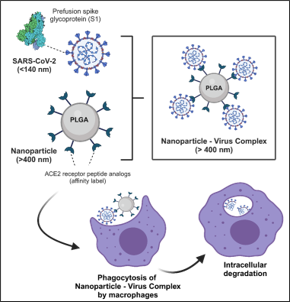
MoA of functionalized particles (modified from Hortschansky et. al., Unpublished).
Technology Description
- Modality: PLGA/PLGA-PEG nanoparticles (≈ 360–600 nm) functionalized via maleimide/DBCO to show spike-protein minibinders
Dose benchmark: free LCB1 IC₉₀ ≈ 11.4 nM, IC₅₀ ≈ 4.86 µg/mL (pseudovirus); IC₉₀ ≈ 3.7 µg/mL (wt SARS-CoV-2)
Safety/TD: no membrane damage or metabolic impairment in Calu-3 at tested ranges; specificity confirmed by lack of effect on MERS-CoV
Therapy type: effective means of viral neutralization and clearance without acting at the cell level
Commercial Opportunity
The technology is available for co-development and in-licensing partnerships.
Development Status
Current work is optimizing production and scale-up of functionalized nanoparticles, advancing in vivo validation, and refining target-specific designs toward standardized diagnostic and therapeutic kits.
Patent Situation
A European patent was filed in November 2023 (EP23209601) followed by a PCT application (WO2025104091) in 2024.
Further Reading
Original publication – Unpublished.
Licensing Contact

Dr Alejandro Restrepo Arango
Technology ScoutT: +49 531 618120-92
restrepo@ascenion.de
Institute of Origin