
Functionally Selected HCV E2 Glycoproteins for a Broadly Protective Hepatitis C Vaccine
Invention Novelty
Whereas prior recombinant HCV immunogens are typically single, arbitrarily chosen E1E2 or E2 constructs that do not take the genetic variability of HCV into account, and while contemporary efforts pursue consensus sequences or structurally stabilized native-like E1E2 heterodimers, this invention systematically screened 13 genetically and functionally diverse E2 variants across six neutralization biotypes to identify antigens or combinations thereof with superior properties. This functional-selection paradigm—demonstrating that genetic distance does not predict neutralization behavior—is a departure from purely sequence-driven or single-strain approaches.
Value Proposition
A prophylactic HCV vaccine addresses a substantial unmet need: an estimated 47 million people were living with HCV infection in 2024, and while curative antivirals exist, global access remains limited and these drugs do not stop reinfection, making a durable vaccine critically needed. The technology's flexibility is a key commercial asset: the selected E2 antigens can be deployed as soluble adjuvanted protein, displayed on nanoparticles, or delivered as mRNA or viral-vector nucleic acid, enabling multiple product formats and partnering routes
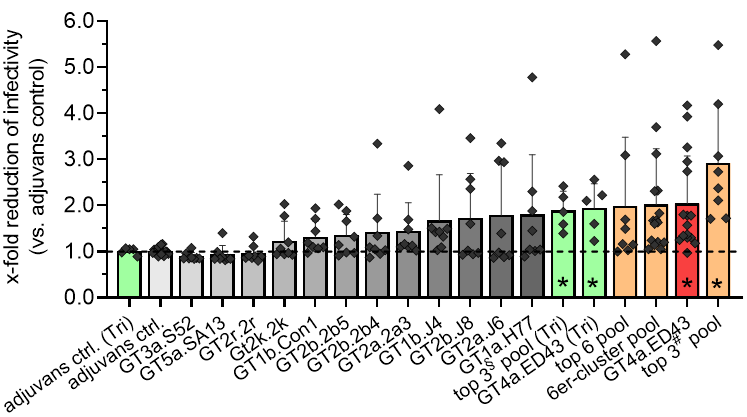
Neutralisation efficiancy of mice sera after immunisation with single E2 glycoproteins or combinations thereof
Technology Description
The invention provides a composition comprising glycoprotein E2 from HCV strain GT4a.ED43, wherein the glycoprotein is a soluble glycoprotein not comprising a transmembrane region, and/or displayed on the surface of a nanoparticle, optionally, wherein the composition comprises an adjuvant. The soluble form is expressed as a secreted, truncated ectodomain in Drosophila S2 or mammalian cells, purified and adjuvanted. In immunized mouse models including humanized Trianni mice, the GT4a.ED43 antigen most effectively induced antibodies neutralizing all reference viruses tested, reducing infectivity to 63.8% relative to adjuvant control. Alternatively, the E2 antigen is delivered via nucleic acid—RNA, optionally mRNA formulated in a lipid nanoparticle, a non-HCV viral nucleic acid, or DNA. Advantageously, defined three-strain pools such as ED43/2b5/J8 further increased cross-neutralization breadth.
Commercial Opportunity
The technology is available for licensing and co-development.
Development Status
Validation was performed in multiple cell culture infection studies and confirmed in vivo in mice, demonstrating that immunization with adjuvanted soluble HCV E2 glycoproteins elicited strong neutralizing antibody responses comparable to or exceeding natural human HCV infection.
Patent Situation
Applications based on WO2025/078593 with priority of 2023 are pending in Europe, USA, India and China.
Further Reading
Bankwitz et al. (2021) Hepatitis C reference viruses highlight potent antibody responses and diverse viral functional interactions with neutralising antibodies. Gut. 2021 Sep;70(9):1734-1745.

Institute of Origin