Inhalable Membrane-Active Peptide Targeting Early, Lipid-Dependent NLRP3 Inflammasome Activation
Invention Novelty
The invention discloses a previously unrecognized mechanism of action for inhibiting the NLRP3 inflammasome. The synthetic membrane-active antimicrobial peptide Pep19-2.5 (and selected derivatives) selectively inhibits NLRP3 inflammasome assembly without detectable binding to NLRP3 itself. Mechanistically, Pep19-2.5 preferentially binds to PI4P-containing membranes and dispersed trans-Golgi network (dTGN) structures, which could interfere with NLRP3 recruitment to the dTGN – distinct from MCC950, the NACHT domain-binding template of most clinical and preclinical candidates, which shows adverse effects and limited efficacy against certain NLRP3 mutations. Critically, the peptide operates independently of its known LPS-neutralizing function: inhibition occurs under TLR2 priming and against TLR4-independent house dust mite (HDM) stimulation.
Value Proposition
The technology addresses a large unmet need across NLRP3-driven disorders, ranging from chronic inflammatory immune disorders to lifestyle disorders such as cardiovascular diseases. A lead indication is asthma (>260 million patients worldwide), where standard treatment still relies on corticosteroids, which cause serious side effects when applied systemically, and severe, uncontrolled or type-2-low phenotypes are often associated with corticosteroid refractoriness. The peptide is amenable to local delivery by inhalation; its inhibition of urate (MSU) crystal-induced IL-1β release suggests further sterile-inflammatory indications such as gout.
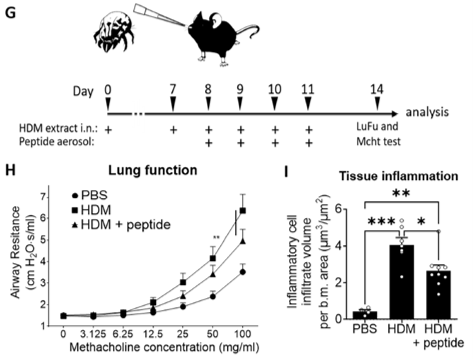
Pep19-2.5 reduces pro-inflammatory response to house dust mite (HDM) extract in vivo. (G) Treatment protocol for HDM induced allergic asthma mouse model. (H) Airway resistance in response to methacholine inhalation (I) inflammatory cell infiltrate volume in lung tissue per epithelial basal membrane (b.m.) area (Engelhardt et al., 2026).
Technology Description
Pep19-2.5 engages host-cell membranes to disrupt an early step in inflammasome assembly. In TLR2-primed human primary monocytes, IL-1β secretion induced by nigericin or MSU crystals was inhibited (IC50 8.0 µM and 12 µM), whereas NLRP1- and AIM2-dependent IL-1β release was not. Unlike truncated or scrambled variants, the peptide induced a sustained rigidization of the membrane; it bound significantly more strongly to PI4P- than to PI3P-containing membranes. Functionally, Pep19-2.5 inhibited ASC oligomerization and speck formation and attenuated processing of pro-IL-1β and GSDMD without inhibiting caspase-1 enzymatic activity. No direct binding to NLRP3 was detected, consistent with an indirect, membrane-proximal mode of action.
Commercial Opportunity
The mechanistically differentiated approach addresses NLRP3-driven diseases with high unmet medical need, opening in-licensing and partnering opportunities in respiratory and inflammatory indications. GMP-grade Pep19-2.5 has been produced, and local applicability (inhalation) supports a differentiated profile versus systemic small-molecule inhibitors.
Development Status
Preclinical proof of concept: in vitro, inhibition of NLRP3-dependent IL-1β secretion in human primary monocytes and macrophages; in vivo, aerosol application during allergen challenge improved lung function and reduced airway inflammation in an HDM asthma mouse model without observable adverse effects (see Figure).
Patent Situation
Priority application EP26188189 (June 2026): Pep19-2.5 and variants for use in NLRP3-mediated diseases; inhaler.
Further Reading
Engelhardt et al. (2026) Adv. Sci. 20: e76587.
Licensing Contact

Dr Torsten Stachelhaus
Technology ManagerT: +49 40 1888 43 48
stachelhaus@ascenion.de
Institute of Origin