
Novel CARs for the Treatment of Inflammatory Bowel Disease
Keywords
Chimeric Antigen Receptor, Inflammatory Bowel Disease, Crohn’s Disease, Ulcerartive Colitis, Regulatory T-cells
Invention Novelty
The invention introduces highly specific chimeric antigen receptors (CARs) as a novel approach for the treatment of inflammatory bowel disease (IBD), specifically targeting chronic conditions such as Crohn’s disease and ulcerative colitis. The newly developed CARs include single-chain variable fragments (scFvs) that selectively recognize antigens associated with the inflamed intestinal environment, namely Meprin 1α (MEP1A) and Cadherin 17 (CDH17). In particular, the antigen-specific MEP1A- or CDH17-CARs are engineered to trigger an immunosuppressive response exclusively at the site of inflammation, thereby avoiding systemic immune suppression - a major limitation of current IBD therapies.
Value Proposition
The technology provides an innovative immunotherapeutic strategy for treatment of IBD with a focus on Crohn´s Disease and ulcerative colitis. Already available immunosuppressive drugs often lead to systemic effects, increasing the risk of infections and malignancies. In contrast, CAR-Tregs targeting MEP1A or CDH17 ensure localized immunosuppression and precisely aim at affected intestinal tissues. This substantially reduces systemic side effects. In addition, the application of autologous T cells for CAR-expression ensures high biological compatibility and co-expression of FOXP3 leads to long-term stability of the Treg phenotype. Therefore, considerable therapeutic and economic value can be seen in this new invention.
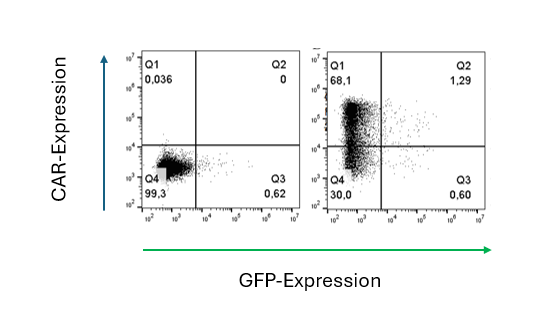
FACS analysis confirmed background level activation for untransduced cells (left) and CAR-expression and activation for CDH17-CAR transduced cells (right).
Technology Description
The core of the invention are newly engineered CARs that are expressed in Tregs and are either directed at MEP1A or CDH17. The single chain variable fragments (scFvs) of these CARs were identified by phage display and fused to intracellular signaling domains (CD28 and CD3ζ) for Treg activation upon antigen engagement. Tregs are derived from autologous T-cells and genetically modified using retroviral transduction to express the CAR. To maintain the regulatory phenotype of Tregs the CARs are co-expressed with FOXP3. The activation of CAR-Tregs was confirmed via in vitro co-culture assays with target-expressing cell lines. In summary, the technology enables antigen-specific immune suppression, minimizes off-target effects, and offers an innovative therapeutic solution for chronic inflammations caused by autoimmune diseases of the intestinal tract.
Commercial Opportunity
In-licensing is possible.
Development Status
In vitro studies have successfully demonstrated proof of concept of the novel technology.
Patent Situation
International PCT application (PCT/EP2025/069078) with priority of 2024 is pending.

Institute of Origin