Novel Myxopyronin Analogues and Myxopyronin Genecluster for Mutasynthesis
Keywords
Myxopyronin, RNA polymerase, MDR-TB, MRSA, Antibiotic resistance
Invention Novelty
This novel antibiotic approach targets multidrug-resistant tuberculosis (MDR-TB) and extensively drug-resistant tuberculosis (XDR-TB) pathogens by addressing innovative mechanisms in RNA polymerase inhibition.
Value Proposition
Tuberculosis (TB) remains a global health challenge. The WHO estimates that one-third of the global population is infected with TB, with 8.7 million new cases and 1.4 million deaths in 2011 alone, including 430,000 HIV-positive patients. While first-line TB antibiotics like rifampicin and isoniazid are effective, decades of use have led to resistance, particularly in MDR-TB and XDR-TB strains. These resistant pathogens are unresponsive to both first- and second-line antibiotics, creating a high demand for innovative drugs targeting novel pathways.
Myxopyronin, a member of the alpha-pyrone antibiotic family, represents a promising solution. It interacts with the “switch region” of RNA polymerase (RNAP), a unique target distinct from rifampicin's mode of action, reducing the likelihood of cross-resistance. Its unique targeting mechanism enables potential combined therapies and optimized pharmacological derivatives, broadening its application to combat resistant pathogens like MRSA.
Technology Description
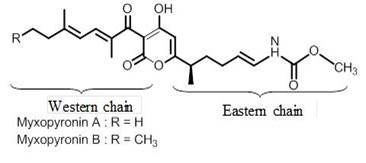
Myxopyronin, an alpha-pyrone antibiotic, exhibits potent antibacterial activity by targeting the "switch region" of RNA polymerase (RNAP), distinct from the binding site of rifampicin. This unique mechanism minimizes cross-resistance and supports combination therapies. Recent studies on RNAP-alpha-pyrone interactions enable the design of optimized myxopyronin derivatives with expanded activity spectra, including potential effectiveness against MRSA. Utilizing the myxopyronin biosynthesis gene cluster, novel analogues can be developed through mutasynthetic approaches by blocking the synthesis of one chain and incorporating synthetic precursors. First-generation analogues are already available for evaluation.
Commercial Opportunity
Technology is offered for cooperative development of novel myxopryronin analogues by genetic engineering.
Development Status
The unique targeting of RNA polymerase has been extensively studied, and first novel analogues of myxopyronin are ready for evaluation.
Patent Situation
A European patent application was filed in April 2013.
Further Reading
Sucipto et al. 2013. Exploring Chemical Diversity of α-Pyrone Antibiotics: Molecular Basis of Myxopyronin Biosynthesis. ChemBioChem 2013, 14, 1581–1589.
Licensing Contact

Dr Alejandro Restrepo Arango
Technology ScoutT: +49 531 618120-92
restrepo@ascenion.de
Institute of Origin