Novel Therapy for Treatment of Alzheimer´s Disease
Invention Novelty
The presented invention reveals an innovative therapeutic approach for treatment of Alzheimer´s Disease (AD). Researchers discovered that Nitarsone and derivatives thereof have a very promising therapeutic effect on AD by preventing the Jacob-induced transcriptional inactivation of cAMP-response element-binding protein (CREB). The transcriptional inactivation of CREB plays a key role in the progression of the neurodegenerative disease and is tightly linked to cognitive decline. For the first time in vitro and in vivo studies revealed the excellent properties of Nitarsone to preserve the transcriptional function of CREB and therefore enabling the maintenance of neuronal function.
Value Proposition
The transcriptional activator CREB is essentially involved in plasticity-related gene expression and its inactivation leads to severe impairment of synaptic function and, ultimately, to neurodegeneration. At present, no treatment options are available to prevent Jacob-induced transcriptional inactivation of CREB during development of AD. Nitarsone efficiently inhibits the inactivation of CREB, therefore supporting cognitive function and offering a novel therapeutic approach for treatment of AD. For this reason, Nitarsone and derivatives thereof are a promising step forward in developing a treatment of AD, in particular as existing therapeutic approaches predominantly target later stages of AD.
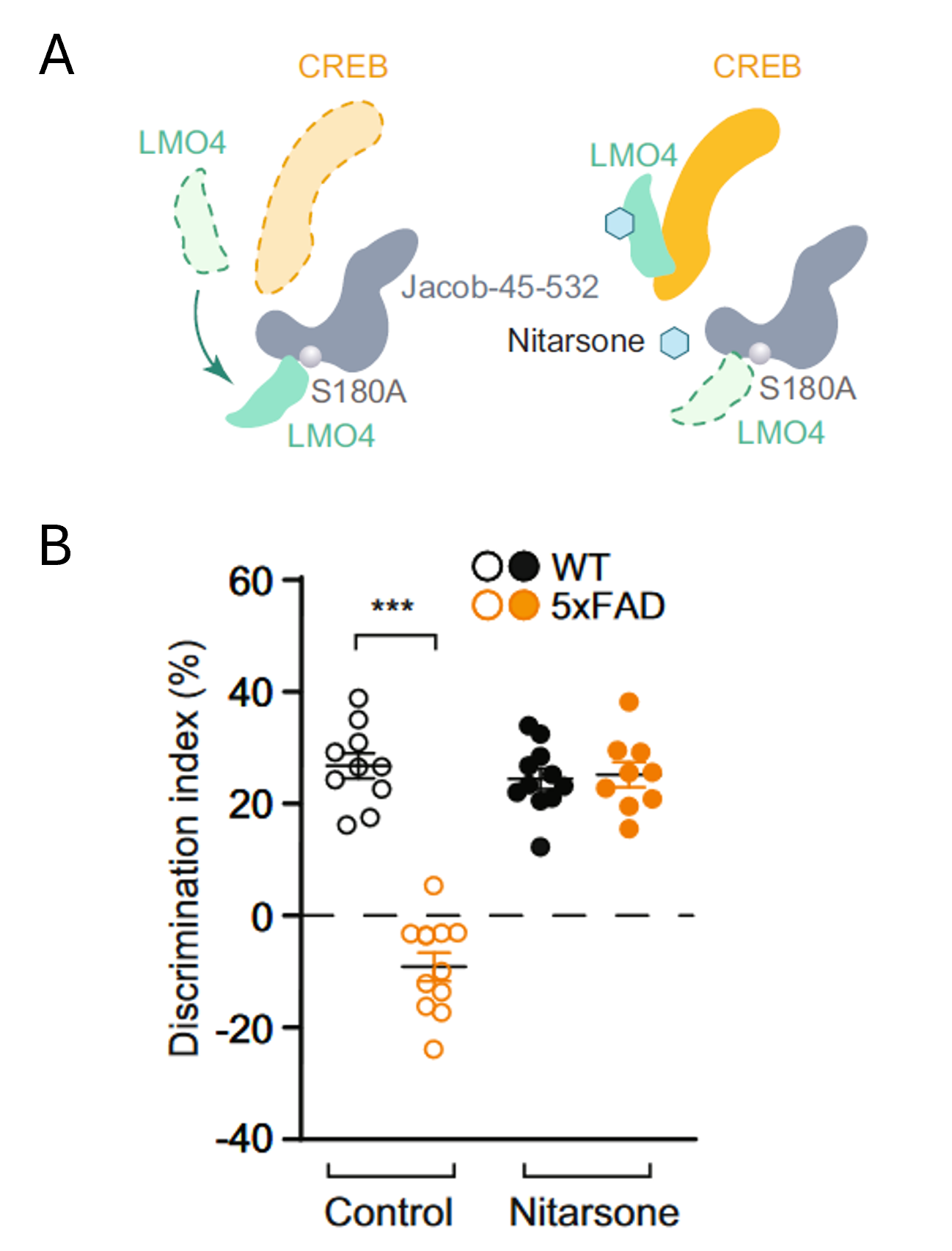
(A) Unphosphorylated Jacob displaces LMO4 from CREB. Nitarsone blocks binding of Jacob and LMO4. (B) Nitarsone rescues short-term memory impairment in Y-maze object recognition task in an AD mouse model. (Grochowska, Kreutz et al., 2023)
Technology Description
The innovative therapeutic approach is based on disrupting the molecular interaction between the synapto-nuclear protein messenger Jacob and LIM domain only 4 (LMO4), a transcriptional co-activator of CREB. As part of the pathological development of AD LMO 4 is displaced from CREB through a non-phosphorylated isoform of Jacob. This displacement leads to transcriptional inactivation of CREB with the subsequent loss of plasticity-related gene expression and finally results in synaptotoxicity. The use of molecular modelling strategies and screening of compound libraries revealed Nitarsone as a novel drug candidate for the prevention of transcriptional inactivation of CREB. Subsequent in vitro and in vivo studies confirmed the capability of Nitarsone to inhibit Jacob-induced displacement of LMO4 and revealed the preservation of synaptic plasticity in a disease relevant animal model. In summary, therapeutic intervention with Nitarsone offers a very promising approach for the treatment of synaptic dysfunction in AD.
Commercial Opportunity
In-licensing or collaboration for further development is possible.
Development Status
In vitro and in vivo studies in an AD animal model have been performed.
Patent Situation
Patent applications in EP and US (based on PCT application WO 2023/187141A1) with priority of 2022 are pending.
Further Reading
Grochowska KM, Gomes GM, Raman R, Kaushik R, Goldschmidt J, Friese MA, Rossner S, Navarro G, Remy S, Reissner C, Karpova A, Kreutz MR et al. 2023. Jacob-induced transcriptional inactivation of CREB promotes Aβ-induced synapse loss in Alzheimer's disease. EMBO J. 42(4):e112453. doi: 10.15252/embj.2022112453.

Institute of Origin