
Novel treatment for sepsis in newborns
Keywords
Sepsis, neonatal diseases, S100A8/A9 Alarmins
Invention Novelty
The novel technology provides an innovative approach for the prevention or treatment of hyperinflammation and septic diseases in preterm babies or newborns delivered by Caesarean section. The innate immune system represents the first line of defense against invading pathogens. It is assumed that an impaired immune response by innate immune cells is the major reason for an elevated risk of neonatal death from sepsis. Research studies demonstrated that premature infants and newborns delivered by Caesarean section have a much higher risk of developing sepsis than infants born at full term and by vaginal birth. In 2011 about 9% of all children in Germany were born before 37th week of pregnancy and especially premature births revealed an elevated risk of developing sepsis.
Value Proposition
About 5% of all deaths under the age of five are a consequence of a neonatal septic disease. Thus, neonatal sepsis is a major risk factor for childhood mortality and there is a strong need to identify novel immune-modulatory strategies for prevention or therapy of postnatal inflammatory disorders in newborn patients.
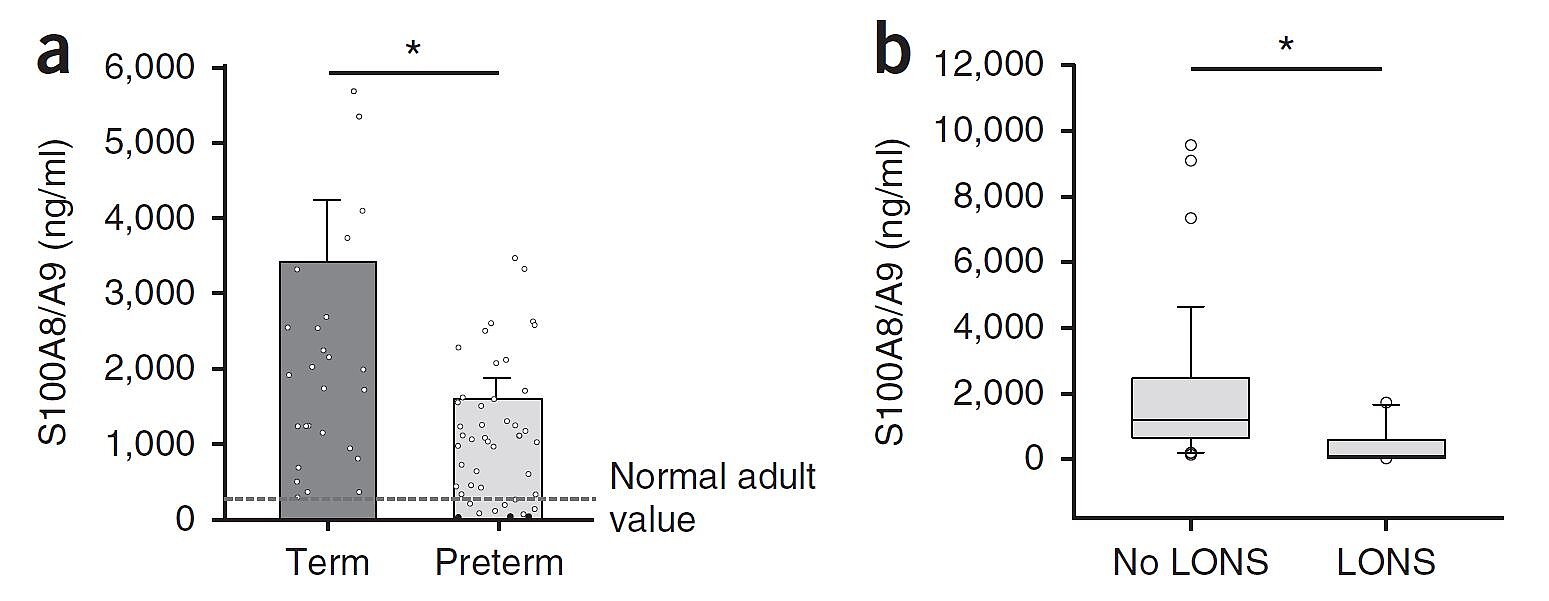
Cord blood levels of S100A8/A9 are inversely correlated with the risk of sepsis in human neonates. (a) Serum levels of S100A8/A9 in cord blood samples from term and preterm human newborns. (b) Cord blood levels of S100A8/A9 in preterm newborns without LONS (late-onset neonatal sepsis) or with later occurrence of LONS.
Technology Description
In detail, the technology relates to perinatal alarmins S100A8 and S100A9 of the S100 protein family. These receptor ligands were identified as promising therapeutics in NF-κB-associated postnatal inflammatory diseases, such as TLR4- and/or TLR2-mediated inflammatory response. Whereas in adults serum levels of S100 protein family are associated with the amplification of the inflammatory response, in newborns the function of S100 proteins is surprisingly different. In newborns S100 proteins efficiently inhibit a systemic hyperinflammatory response by inducing immune and stress tolerance. Particularly important, S100 proteins prevent overwhelming inflammation without impairing bacterial pathogen defense. Thus, S100 proteins are of great promise for therapy of hyperinflammation and septic diseases in preterm babies or newborns delivered by Caesarean section.
Commercial Opportunity
In-licensing is possible.
Development Status
In vitro and in vivo studies have been performed at Hannover Medical School and University of Münster.
Patent Situation
Patents have been granted in Europe (EP 3534931, national validation in DE, CH, FR and GB), USA (US 11,253,570 B2), China (ZL 2017 8 0065576.8) and Canada with priority of 2016.
Further Reading
Ulas et al. (2017) S100-alarmin-induced innate immune programming protects newborn infants from sepsis. Nat Immunol. 2017 Jun;18(6):622-632.
Heinemann et al. (2016) In neonates S100A8/S100A9 alarmins prevent the expansion of a specific inflammatory monocyte population promoting septic shock. FASEB J. 2017 Mar;31(3):1153-1164
Pirr et al. (2017) High amounts of S100-alarmins confer antimicrobial activity on human breast milk targeting pathogens relevant in neonatal sepsis. Front Immunol. 2017 Dec 13;8:1822. doi: 10.3389/fimmu.2017.01822. eCollection 2017
Willers et al. (2020). S100A8 and S100A9 Are Important for Postnatal Development of Gut Microbiota and Immune System in Mice and Infants. Gastroenterology. 10.1053/j.gastro.2020.08.019
Viemann (2020). S100-Alarmins Are Essential Pilots of Postnatal Innate Immune Adaptation. Front Immunol. 10.3389/fimmu.2020.00688

Institute of Origin