Organoid-Trained Machine Learning for Patient-Specific Cancer Therapy Prediction
Keywords
precision-oncology, patient-derived organoids (PDOs), machine learning, therapy response prediction, bladder cancer
Invention Novelty
Researchers at Charité – Universitätsmedizin Berlin have developed a machine-learning platform, UroMe.ai, that predicts patient-specific cancer therapy responses from molecular tumour data alone, using a model previously trained on drug-response datasets from patient-derived organoids (PDOs). Currently, conventional therapy-response predictors rely on retrospective, clinical-trial or single biomarker data. The novelty here lies in decoupling functional drug testing from the prediction step: the core of the machine learning model uses training data derived from PDOs, which act as "biological twins" to test responses to a defined set of clinically approved drugs on an individual patient level. Uniquely, training data also include immune cells from tissue fragments to capture the entire molecular response profile after immunotherapy. Of note, instead of using drug-response data directly as the predictor, this approach anchors a molecular-data-only classifier, differentiating it from existing single-marker methods in the field.
Value Proposition
While overall survival is generally favourable, the high risk of recurrence in bladder cancer creates a considerable clinical burden. Prognosis deteriorates dramatically once the disease metastasises, with 5-year survival rates of only 5%. Despite an expanding treatment landscape, treatment response vary considerably, therapy failure remains prevalent, and predictive markers for therapy efficacy are lacking. UroMe.ai addresses this unmet need by combining patient-specific therapy prediction with speed and accessibility: because PDOs are used only to generate treatment-response data for algorithm training, once trained, the classifier can predict treatment response from molecular data alone, providing patient-specific predictions within days of diagnosis. In contrast, direct drug-response testing in patient-specific organoids requires 1–2 months of laboratory work. This reduces the need for viable patient tissue and long waiting times. Commercially, the technology is relevant to pharmaceutical, biotechnology, and diagnostics companies for drug development, clinical trial patient selection, and precision-medicine applications.
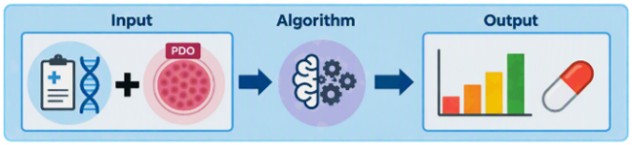
The UroMe.ai algorithm is trained using patient-specific molecular features generated from tissue or liquid biopsies, which are labelled with drug response data from PDO cultures from the same patient. New patient-specific molecular features without known response labels are matched to PDO biobank molecular profiles to predict clinical drug responses (source: modified from EP26171297.0).
Technology Description
The method relies on a machine learning model trained on molecular data from organoids and immune cells derived from patient samples, which are exposed to clinically approved cancer therapies, with the aim of building a database of treatment response probability predictions. By measuring parameters such as cell viability, activation-marker expression, and reactivation of immune cells, responses are combined with molecular and clinical features to train the predictive classifier. In clinical practice, patient-specific molecular features derived from individual tissue or liquid biopsies are then matched against the generated model trained on therapy response data from the PDO biobank to give a patient-specific prediction of treatment response.
Commercial Opportunity
We are looking for a licensing and/or cooperation partner.
Development Status
Current efforts are aimed at expanding the organoid biobank underlying the algorithm, which is now trained on ~150 urogenital samples. Next steps include the retrospective validation of the algorithm using tissue from patients with known clinical histories.
Patent Situation
European patent application EP26171297.0 was filed in April 2026.

Institute of Origin